
The New Hope MHCS

Social Wellness Month: Why the Quality of Your Relationships Is a Mental Health Issue

We tend to think of mental health as something that happens inside a person – in the brain, in the body, in private thought and feeling. And it does happen there. But it does not happen only there. Some of the most powerful determinants of mental health are not internal at all. They are relational. They live in the space between people – in the quality of connection, the experience of being known, and the sense that one is genuinely part of something larger than oneself.

July is Social Wellness Month – a dedicated observance that invites people to reflect not just on how many relationships they have, but on the health and depth of those relationships. It is a distinction that matters enormously. Research consistently shows that it is the quality of social connection, not its quantity, that predicts mental health outcomes. A person can be surrounded by acquaintances and deeply isolated. A person can have one or two close relationships and be profoundly well-supported. The number is almost beside the point.

What Is Social Wellness?

Social wellness refers to the overall health of your relationships and your capacity for meaningful connection. It encompasses how well you communicate with others, how effectively you navigate conflict, how comfortable you are with both intimacy and independence, and whether the relationships in your life leave you feeling energized or depleted.

A person with strong social wellness does not necessarily have a large social circle. They have relationships characterized by mutual respect, honest communication, and genuine care. They feel safe being vulnerable with at least a few people. They are able to set limits in relationships without excessive guilt or fear of abandonment. They give and receive support in ways that feel balanced rather than one-sided.

Social wellness is not a fixed state. It fluctuates with life circumstances, and it can be actively developed. Like physical fitness, it responds to intentional effort.

The Mental Health Impact of Relationship Quality

The connection between relationship quality and mental health is one of the most robust findings in all of psychological research. The Harvard Study of Adult Development – one of the longest-running studies of human wellbeing ever conducted, spanning more than 80 years – found that the single strongest predictor of mental health, physical health, and longevity in later life was not wealth, fame, or professional achievement. It was the quality of close relationships.

People who reported warm, close relationships in midlife were healthier and happier at 80 than those who had been objectively more successful by conventional measures. People in high-conflict or emotionally unsupportive relationships showed worse health outcomes than those who were alone. The study’s conclusion was unambiguous: good relationships keep us healthier and happier. Full stop.

The mechanisms behind this are multiple. Close relationships provide emotional regulation support – having someone who can help you process difficult experiences reduces the physiological burden of stress. They provide practical support during health crises. They offer a sense of identity and belonging that protects against depression. And they create the experience of being genuinely known – which is one of the most fundamental human needs.

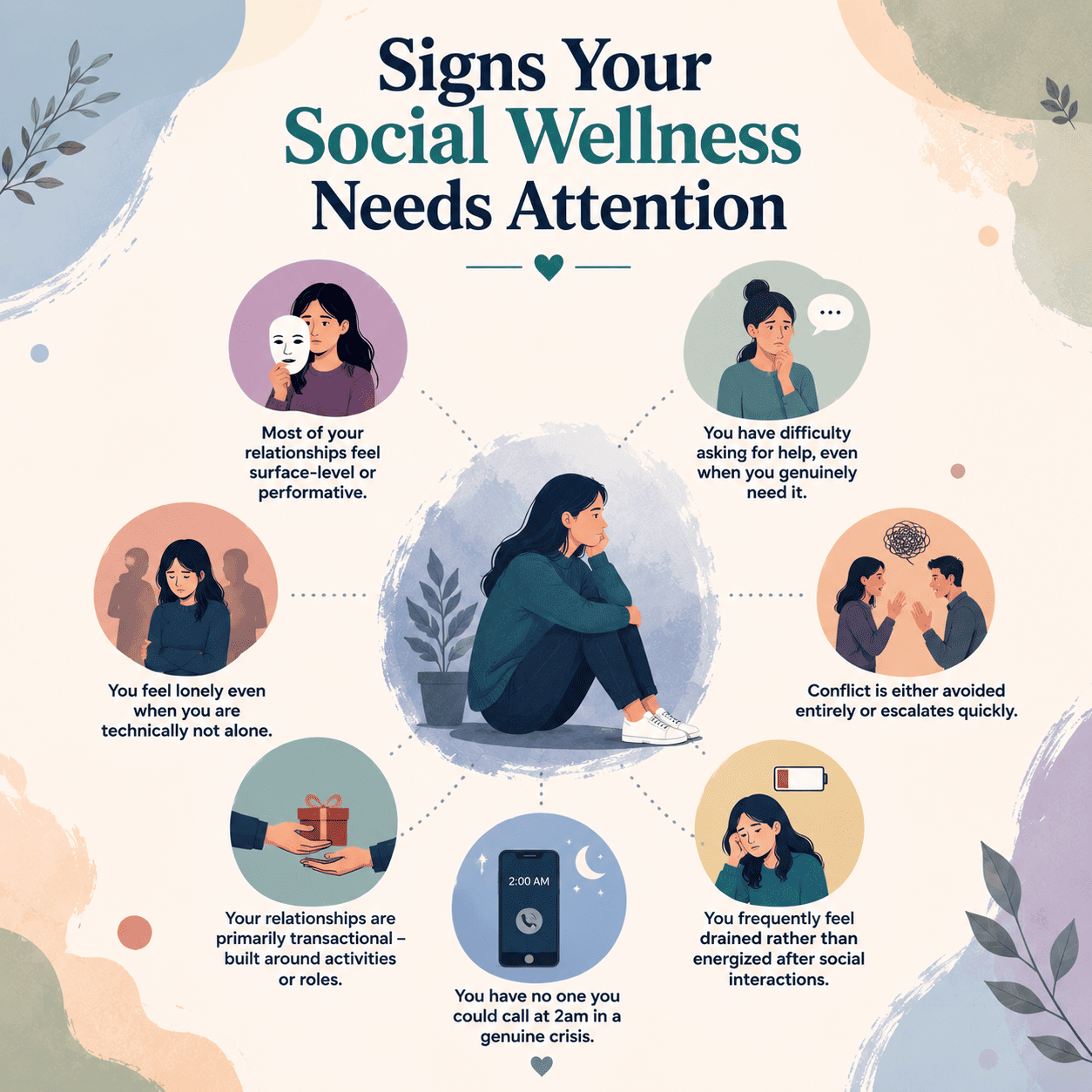
Signs Your Social Wellness Needs Attention

Social wellness is not always easy to assess honestly, because the gaps in our relationships can be normalized over time until they no longer register as gaps. Some indicators that deserve closer attention:

Signs Your Social Wellness Needs Attention
  • Most of your relationships feel surface-level or performative – you show up in a version of yourself rather than as yourself.
  • You have difficulty asking for help, even when you genuinely need it, because it feels like too much to ask.
  • Conflict in your relationships is either avoided entirely or escalates quickly – the middle ground of honest, calm disagreement feels inaccessible.
  • You frequently feel drained rather than energized after social interactions.
  • You have no one you could call at 2am in a genuine crisis – not because people would not want to help, but because you have not built that level of trust with anyone.
  • Your relationships are primarily transactional – built around shared activities or roles rather than genuine emotional exchange.
  • You feel lonely even when you are technically not alone.
Building Social Wellness: What Actually Works

Depth Over Breadth

The most consistent finding in relationship research is that depth matters more than number. One or two relationships in which you feel genuinely seen and supported are more protective of mental health than a wide network of pleasant but shallow connections. This does not mean avoiding large social networks – but it does mean intentionally investing in the relationships that have the potential for real depth, even when that investment feels vulnerable or effortful.

Presence Over Performance

One of the most common ways social wellness deteriorates is when relationships become increasingly performative. We show up to social engagements in a curated version of ourselves, maintain a comfortable surface, and leave feeling vaguely unsatisfied without understanding why. Real social wellness requires real presence – actually engaging with another person’s experience rather than managing the impression you are making. This is a skill that can be deliberately practiced.

Honest Communication

Relationships that cannot contain honest communication eventually become relationships that cannot contain real intimacy. The ability to express genuine needs, to disagree without destabilizing the relationship, and to have difficult conversations while remaining connected is central to social wellness. For many people, this is the hardest and most transformative area to develop – and the one that therapy can most directly support.

Community and Belonging

Beyond one-on-one relationships, a sense of belonging to something larger – a community, a neighborhood, a faith tradition, a shared-interest group – provides a dimension of social wellness that individual relationships alone cannot fully supply. The experience of being part of a collective that values your presence and contribution is a distinct and powerful protective factor for mental health.

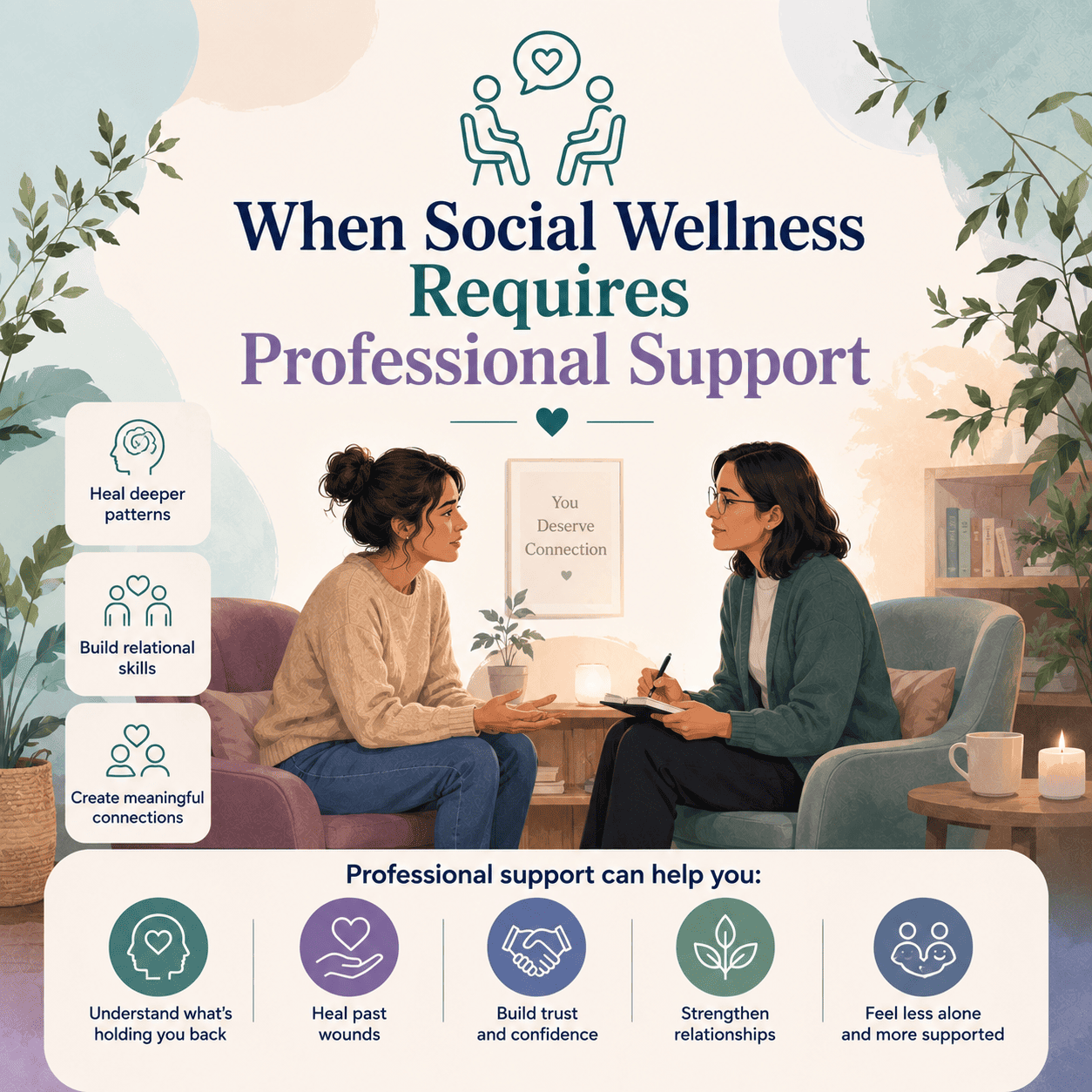
When Social Wellness Requires Professional Support

For some people, building social wellness is straightforwardly about time and intention. For others, it is blocked by deeper patterns: attachment wounds from early relationships, social anxiety that makes genuine connection feel dangerous, depression that has eroded the motivation for connection, or trauma histories that have made trust feel impossible.

In these cases, addressing the underlying patterns in therapy is not a distraction from building social wellness – it is the prerequisite. A therapist can help you understand what is getting in the way, work through the experiences that created these patterns, and develop the specific relational skills that make meaningful connection accessible.

At The New Hope Mental Health Counseling Services, our licensed therapists support individuals navigating social anxiety, relationship challenges, loneliness, and the deeper patterns that make genuine connection feel out of reach. As a leading mental health clinic in New York, we offer both individual and relationship-focused therapy – in-person and virtually – to help you build the social wellness that supports every other dimension of your health. If you are looking for a mental health counselor in New York who understands that relationships are not separate from mental health but central to it, we are here. Visit www.thenewhopemhcs.com to get started.

When Social Wellness Requires Professional Support

A Final Thought

Social Wellness Month is a good time to ask a genuinely honest question: are the relationships in your life actually nourishing you? Not just filling time or providing company – but genuinely feeding something in you that matters. If the honest answer is that they are not, that is not a judgment. It is useful information. And it is something that can change.

Social Wellness - Your Questions Answered

Q1: What is social wellness and why does it matter for mental health?

Social wellness refers to the overall quality and health of your relationships – how authentic, supportive, and mutually respectful they are. It matters for mental health because the quality of social connection is one of the strongest predictors of emotional wellbeing, physical health, and life satisfaction. Research spanning decades consistently shows that warm, genuine relationships are more protective against depression, anxiety, and early death than almost any other lifestyle factor.

Q2: How many close relationships do I need to be socially well?

Quality matters far more than quantity. Research suggests that having even one or two relationships characterized by genuine mutual understanding and support is more protective of mental health than having a large network of surface-level connections. The goal is not to accumulate friends but to cultivate relationships where you can be honest, vulnerable, and genuinely known – and where that is reciprocated.

Q3: Can therapy help improve social wellness?

Yes, and often very directly. Many of the patterns that limit social wellness – difficulty trusting, fear of conflict, discomfort with vulnerability, attachment anxiety – are rooted in earlier experiences that therapy is well-positioned to address. A therapist can help you identify what is getting in the way of genuine connection, work through the experiences that created those patterns, and develop the specific relational skills that make deeper relationships possible.

Q4: What is the difference between social wellness and social anxiety?

Social wellness is a positive dimension of health – the capacity for meaningful, nourishing relationships. Social anxiety is a clinical condition characterized by intense fear of social situations, evaluation by others, or embarrassment – a fear that significantly impairs social functioning. Social anxiety directly undermines social wellness by making connection feel dangerous rather than desirable. The good news is that social anxiety is highly treatable, and addressing it typically produces meaningful improvements in social wellness.

Q5: How do I improve my social wellness if I struggle to make deep connections?

Start with one existing relationship rather than trying to build new ones from scratch. Choose someone where there is already some foundation of trust, and practice being slightly more honest or vulnerable than you usually would be. Notice what happens. Depth grows through repeated small acts of genuine sharing, not through single dramatic conversations. If a specific pattern – like fear of conflict or difficulty trusting – consistently blocks you, working with a therapist is the most efficient way to understand and shift it.

Take the first step toward better mental health!

Fill the Below Form and Schedule a Clinical Consultation with us today→

Skip to content