The New Hope MHCS

Sleep: The New "Mental Health Vital Sign" of 2026 (and Why It Matters)

Sleep: The New "Mental Health Vital Sign" of 2026 (and Why It Matters)

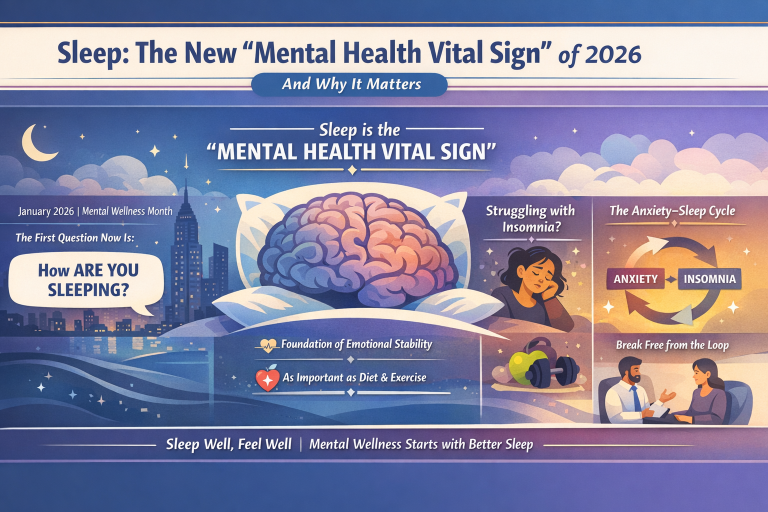
Welcome to January 2026. As we settle into Mental Wellness Month, a significant shift has occurred in how we talk about our minds. If you visit a therapist or a primary care physician in New York today, the first question is likely no longer just “How are you feeling?” but rather, “How are you sleeping?”

For decades, sleep was treated as a passive state-a “shutdown” mode where nothing happened. But in 2026, the medical community officially recognizes sleep as the “Mental Health Vital Sign.” It is no longer just a pillar of health alongside diet and exercise; it is the foundation upon which emotional stability rests.

If you are tossing and turning at 3 AM, staring at the ceiling while your mind races, you aren’t just tired-you are experiencing a critical intersection of neurology and psychology.

The "Chicken or the Egg": The Bidirectional Trap

For years, insomnia was viewed merely as a symptom of mental health struggles. If you were depressed, you slept poorly. If you were anxious, you couldn’t fall asleep. While this is true, 2026 research has solidified our understanding of the bidirectional relationship between sleep and mental health.

It is a two-way street. Yes, anxiety causes sleep loss, but sleep loss actively generates anxiety.

When you are sleep-deprived, the amygdala-the part of your brain responsible for the “fight or flight” response-becomes up to 60% more reactive to negative emotional stimuli. Simultaneously, the prefrontal cortex-the logical “CEO” of the brain that calms you down-loses its ability to regulate the amygdala.

This creates a dangerous feedback loop:

  1. Anxiety/Stress keeps you awake.
  2. Lack of Sleep makes your brain more chemically prone to anxiety the next day.
  3. Increased Anxiety makes it even harder to sleep the next night.

Why 2026 is the Year of Sleep Science

how sleep affects mental health

Why has sleep taken the #1 spot in mental health diagnostics this year? Because we now understand the specific biological mechanisms that occur only when we shut our eyes.

1. The “Brain Wash” (Glymphatic System) During deep NREM sleep, your brain’s glymphatic system kicks into high gear. Think of this as a janitorial service. It flushes out toxic proteins and metabolic waste products that accumulate during the day. When you skip this stage, that “waste” remains, contributing to brain fog, irritability, and arguably, long-term neurodegeneration.

2. Emotional Processing in REM Rapid Eye Movement (REM) sleep is essentially “overnight therapy.” During REM, your brain strips the painful emotional charge from the day’s memories, storing them as neutral narrative memories. Without sufficient REM sleep, we wake up retaining the raw emotional sting of yesterday’s stress, making us more vulnerable to depression and PTSD.

The "Orthosomnia" Trap: A 2026 Warning

Living in a tech-forward era (especially in a hub like New York) means we are surrounded by data. Smart rings, watches, and even “smart mattresses” now give us a “Sleep Score” every morning.

While this awareness is good, it has birthed a new anxiety: Orthosomnia-the obsession with getting “perfect” sleep.

Ironically, stressing about your sleep score spikes your cortisol (stress hormone), which destroys your sleep quality. In 2026, the goal is not a perfect graph on an app; it is how you feel when you wake up. If your tracker says you slept poorly but you feel rested, trust your body, not the algorithm.
Sleep and mental health

Breaking the Cycle: Beyond "Sleep Hygiene"

If you are stuck in the insomnia-anxiety loop, standard advice like “drink chamomile tea” often feels insulting. Real clinical change requires resetting the brain’s association with the bed.

Cognitive Behavioral Therapy for Insomnia (CBT-I) is currently the gold standard treatment-more effective long-term than sleep medication. It focuses on:

  • Sleep Restriction: Temporarily limiting time in bed to increase “sleep drive,” essentially retraining your body to crave sleep at the right time.
  • Stimulus Control: If you don’t fall asleep in 20 minutes, get up. The goal is to break the brain’s association between The Bed and Frustration. The bed is for sleep (and intimacy) only-not for worrying, scrolling, or working.
  • Buffer Zones: Creating a clear separation between the “doing” mode of the day and the “being” mode of sleep.

A New Hope for Rest

In 2026, admitting you have trouble sleeping is an act of bravery and the first step toward mental wellness. You do not have to accept chronic exhaustion as the price of a busy life.

If you are finding that “sleep hygiene” isn’t enough, or if the cycle of anxiety and insomnia feels unbreakable, it might be time to speak to a professional who understands the nuance of this vital sign.

The New Hope Mental Health Services, based in New York, specializes in holistic, evidence-based care that addresses both the mind and the body. We can help you untangle the complex web of sleep and emotion, helping you find the rest-and the hope-you deserve.

Skip to content