The New Hope MHCS

Non-Binary Mental Health - The Unique Challenges and Why Affirming Care Matters

The world is built around a binary. Forms ask for male or female. Bathrooms divide into two. Language defaults to he or she. Strangers assume. And for people whose gender identity does not fit neatly into either category – who are non-binary, genderqueer, genderfluid, agender, or any of the many other identities that exist outside the traditional binary – this constant collision with a world that does not see you accurately is not a minor inconvenience. It is a persistent, cumulative source of stress with real and measurable consequences for mental health.

International Non-Binary Day, observed in July, is an opportunity to bring visibility to experiences that are too often made invisible – not just in social life, but in healthcare, research, and mental health care specifically. This piece is an effort to contribute to that visibility honestly and with specificity.

Who Is Non-Binary?

Non-binary is an umbrella term for gender identities that do not fit exclusively within the categories of man or woman. A non-binary person may experience their gender as a blend of both, as fluid and shifting, as neither, or as something else entirely. Some non-binary people also identify as transgender – meaning their gender identity differs from the sex assigned at birth. Others do not. Some use they/them pronouns. Others use she/her, he/him, or neopronouns. Non-binary is not a single experience – it is a wide and varied terrain of self-understanding.

It is also worth clarifying what non-binary is not. It is not confusion, a phase, or a rejection of reality. It is a genuine dimension of human gender diversity that has been documented across cultures and throughout history, even if the specific terminology is relatively recent in mainstream Western use. The current visibility of non-binary identities reflects increased cultural literacy, not a trend or contagion.

The Mental Health Landscape for Non-Binary People

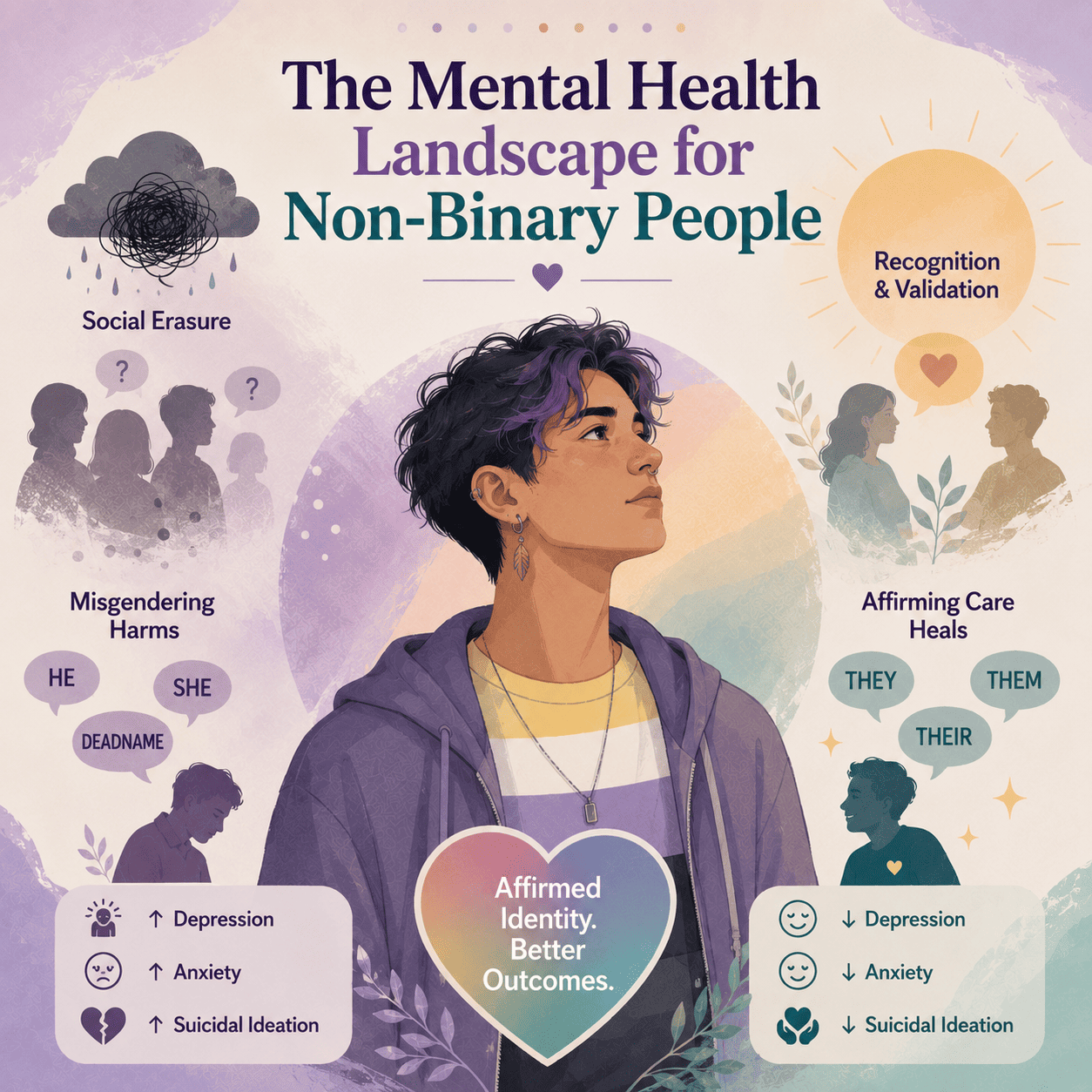
The mental health data for non-binary individuals is sobering. Multiple large-scale studies consistently show that non-binary people experience rates of depression, anxiety, and suicidal ideation that significantly exceed those of both binary transgender people and cisgender individuals. The reasons are not internal to non-binary identity. They are external – rooted in the specific forms of marginalization that non-binary people navigate.

Mental Health Landscape for Non-Binary People

Non-binary individuals face a distinct form of social erasure: unlike binary transgender people, who are at least recognized as a category even when discriminated against, non-binary people often face a world that does not acknowledge their existence as valid. This erasure comes from both cisgender people and, sometimes, from within LGBTQ+ communities – creating a form of double marginalization that compounds its effects.

The stress of constant misgendering – being repeatedly referred to by incorrect pronouns or a name that does not reflect one’s identity – is not merely an interpersonal frustration. Research consistently shows that persistent misgendering is associated with elevated rates of depression, anxiety, and suicidal ideation. Conversely, consistent correct pronoun use by others has been shown to significantly reduce these outcomes. The way people are addressed has direct clinical consequences.
Specific Mental Health Challenges Non-Binary People Face

Minority Stress and Identity Invalidation

Non-binary people experience minority stress – the chronic psychological burden of belonging to a socially stigmatized group – in particularly concentrated forms. Identity invalidation is a central feature of this: the repeated experience of having one’s gender identity questioned, dismissed, or denied by family members, colleagues, healthcare providers, and strangers. Over time, this invalidation creates an environment in which self-trust becomes difficult to maintain. When the world consistently tells you that what you know about yourself is not real, it takes sustained effort to hold onto that self-knowledge.

Healthcare Avoidance

Non-binary individuals are more likely than both cisgender and binary transgender people to avoid healthcare settings entirely. The reasons include past experiences of misgendering or dismissal by providers, lack of knowledge among clinicians about non-binary identities, intake forms and systems that do not accommodate non-binary genders, and the energy cost of having to educate providers before receiving care. This avoidance has consequences that extend well beyond mental health – it affects access to all forms of medical care.

Family and Social Rejection

Family acceptance is one of the most powerful protective factors for the mental health of gender-diverse people – and family rejection is one of the most damaging. Non-binary individuals frequently navigate family environments that range from genuinely accepting to openly hostile, with many falling in the complicated middle ground of families who love their person but struggle to understand or affirm their identity. This ambiguous acceptance – being tolerated but not truly seen – creates its own form of grief and loneliness.

Difficulty Accessing Affirming Care

Even among mental health providers who are broadly supportive of LGBTQ+ clients, specific competence in non-binary experiences varies widely. A therapist who is comfortable with binary transgender clients may still default to binary assumptions, lack familiarity with non-binary-specific stressors, or create a clinical environment in which a non-binary client must repeatedly correct and educate in order to be understood. Genuinely affirming care for non-binary clients requires specific knowledge and ongoing commitment, not just general openness.

What Affirming Care for Non-Binary Individuals Looks Like

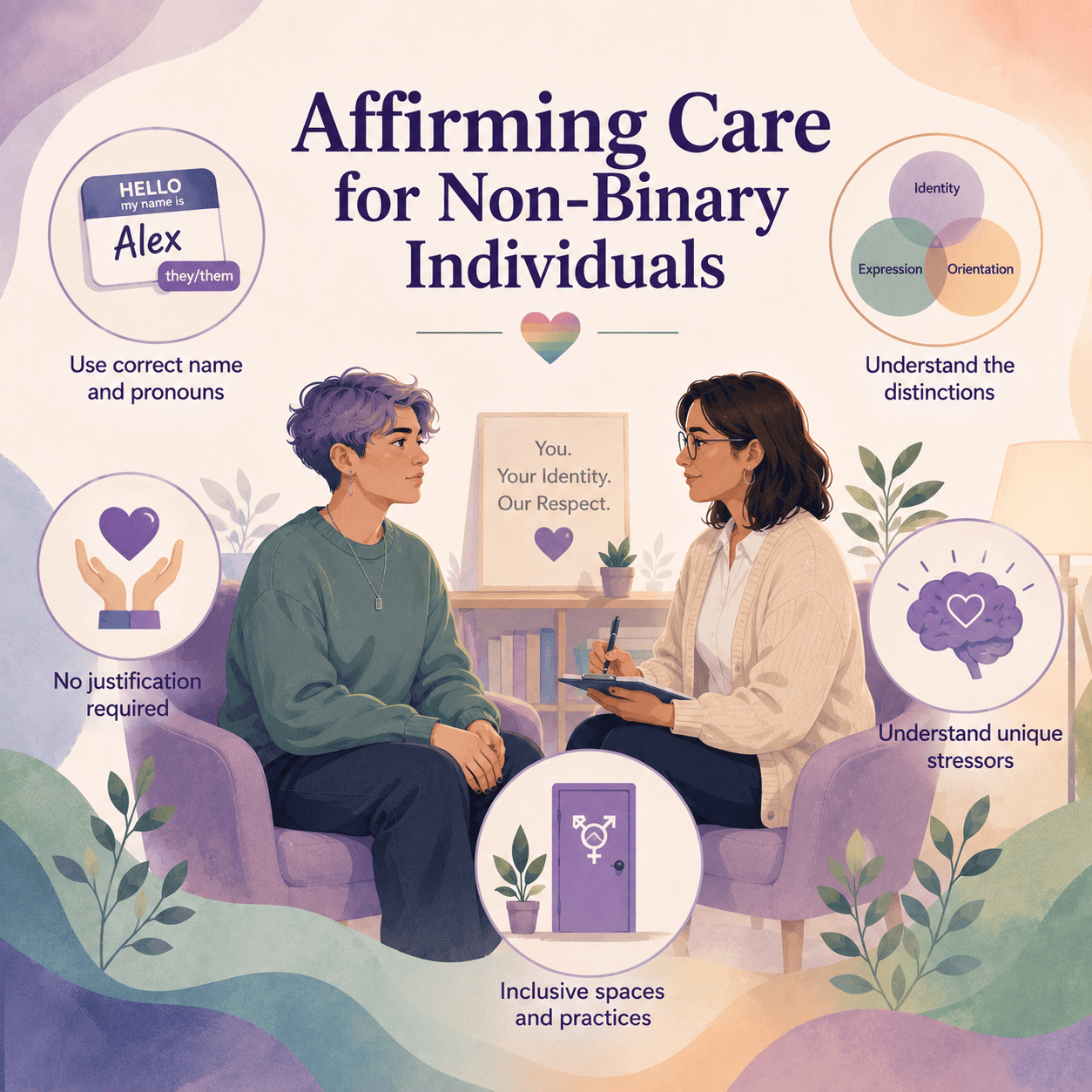
Affirming care for non-binary clients is not complicated in principle, though it does require deliberate practice and ongoing learning. The foundational elements include:

  • Asking for and consistently using a client’s correct name and pronouns from the first contact – not just within sessions, but in all administrative communications and records.
  • Not requiring the client to justify or explain their gender identity before receiving care. A non-binary client should not have to defend their existence before their clinical needs are addressed.
  • Understanding the distinction between gender identity, gender expression, and sexual orientation – and not conflating them.
  • Familiarity with the specific stressors non-binary people face, including minority stress, identity invalidation, misgendering, family rejection, and healthcare avoidance.
  • Clinical environments – intake forms, waiting rooms, signage, bathroom access – that reflect inclusive design rather than binary defaults.
Affirming Care for Non-Binary Individuals

Support Is Available

If you are non-binary and have been hesitant to seek mental health support because of past experiences with providers who did not understand or affirm your identity, that hesitation makes complete sense. And it does not have to be the end of the story. Affirming care exists – provided by clinicians who genuinely understand non-binary experiences and who will not require you to perform your identity or justify your existence in order to receive it.

At The New Hope Mental Health Counseling Services, our team of licensed mental health counselors in New York provides compassionate, affirming care for non-binary individuals and all members of the LGBTQ+ community. We understand that your gender identity is not a complication to be managed – it is part of who you are, and it belongs in the room. As a trusted mental health clinic in New York, we welcome every identity with genuine respect. schedule a consultation with our therapist to learn more.

Final Thought

Non-binary people deserve mental health care that sees them accurately – not as a category to be accommodated, but as whole people whose experiences are valid, whose suffering is real, and whose capacity for flourishing is just as complete as anyone else’s. That is what affirming care means. And it is what everyone deserves.

Non-Binary Mental Health - Your Questions Answered

Q1: Why do non-binary people have higher rates of depression and anxiety?

The elevated rates of depression and anxiety in non-binary populations are not rooted in non-binary identity itself. They are rooted in the chronic stress of navigating a world that routinely erases, invalidates, or misunderstands that identity. Persistent misgendering, family rejection, lack of affirming healthcare, and the energy cost of constant self-advocacy all contribute to a stress load that has direct and measurable mental health consequences.

Q2: What is misgendering and why does it matter for mental health?

Misgendering means referring to someone using incorrect pronouns, name, or gendered language – addressing a non-binary person as he or she when they use they, for example. Research shows that persistent misgendering is directly associated with elevated rates of depression, anxiety, and suicidal ideation in non-binary and transgender individuals. Conversely, consistent correct pronoun use from others produces measurable improvements in mental health outcomes. The language we use to address people has real clinical weight.

Q3: Is non-binary identity a mental health condition?

No. Non-binary identity is not a mental health condition, a disorder, or a symptom of psychological disturbance. Every major medical and psychological organization – including the American Psychological Association, the American Medical Association, and the World Health Organization – recognizes that gender diversity is a normal dimension of human experience. The mental health challenges non-binary people face are not caused by their identity but by the environments that respond to it with hostility or erasure.

Q4: How do I find a therapist who actually understands non-binary experiences?

Ask directly before committing to work with a therapist. Questions worth asking: What experience do you have working with non-binary clients? How do you use pronouns in your practice? Are you familiar with minority stress as it applies to non-binary people? A genuinely affirming therapist will answer these questions without defensiveness and will not make you feel that asking them was inappropriate. Psychology Today’s directory allows filtering by gender identity specialty. At The New Hope Mental Health Counseling Services, we provide affirming care for non-binary individuals in New York. Visit www.thenewhopemhcs.com for more information.

Q5: Can therapy help with gender identity exploration?

Yes – and exploring gender identity in therapy is not something that needs to result in a specific conclusion or label. A good therapist provides a space where you can think through your experience of gender with curiosity and without pressure, at your own pace. They will not push you toward or away from any particular identity or path. For many non-binary individuals, therapy that creates this kind of spacious, non-directive exploration is profoundly valuable – both for identity clarity and for the mental health benefits that come with feeling genuinely seen and supported.

Take the first step toward better mental health!

Fill the Below Form and Schedule a Clinical Consultation with us today→

Skip to content