The New Hope MHCS

Generational Trauma in BIPOC Families: What It Is, How It Shows Up, and How to Begin Healing

There are patterns that move through families like water through rock – slowly, persistently, carving paths that shape everything downstream. The way a parent responds to conflict. The silence around certain subjects. The hypervigilance that arrives for no obvious reason. The difficulty trusting, loving, or asking for help. These patterns often have names we recognize: anxiety, depression, emotional unavailability. What they do not always have is a full explanation of their origin.

Generational trauma – sometimes called intergenerational or transgenerational trauma – is one of the most significant and most underrecognized forces shaping the mental health of BIPOC families today. It does not require a person to have personally experienced the original wound. It is transmitted through parenting, through silence, through the body, and through the countless small behavioral adaptations that traumatized people make in order to survive – adaptations that get passed on, often without words, to the next generation.

What Is Generational Trauma?

Generational trauma refers to the transmission of the psychological and physiological effects of trauma from one generation to the next. It is not metaphorical. Research in epigenetics has shown that trauma can produce heritable changes in gene expression – meaning the biological impact of severe stress can, in certain circumstances, be passed to children and grandchildren even without direct exposure to the original traumatic event.

Beyond the biological, generational trauma is transmitted through learned behavior, family systems, and cultural adaptation. A parent who survived violence by becoming emotionally closed may raise children in an environment of emotional scarcity, not out of lack of love, but because closedness was what kept them safe. Those children learn that emotional openness is dangerous. They teach their own children the same lesson. The original wound recedes into the past while its behavioral and emotional signature persists across generations.

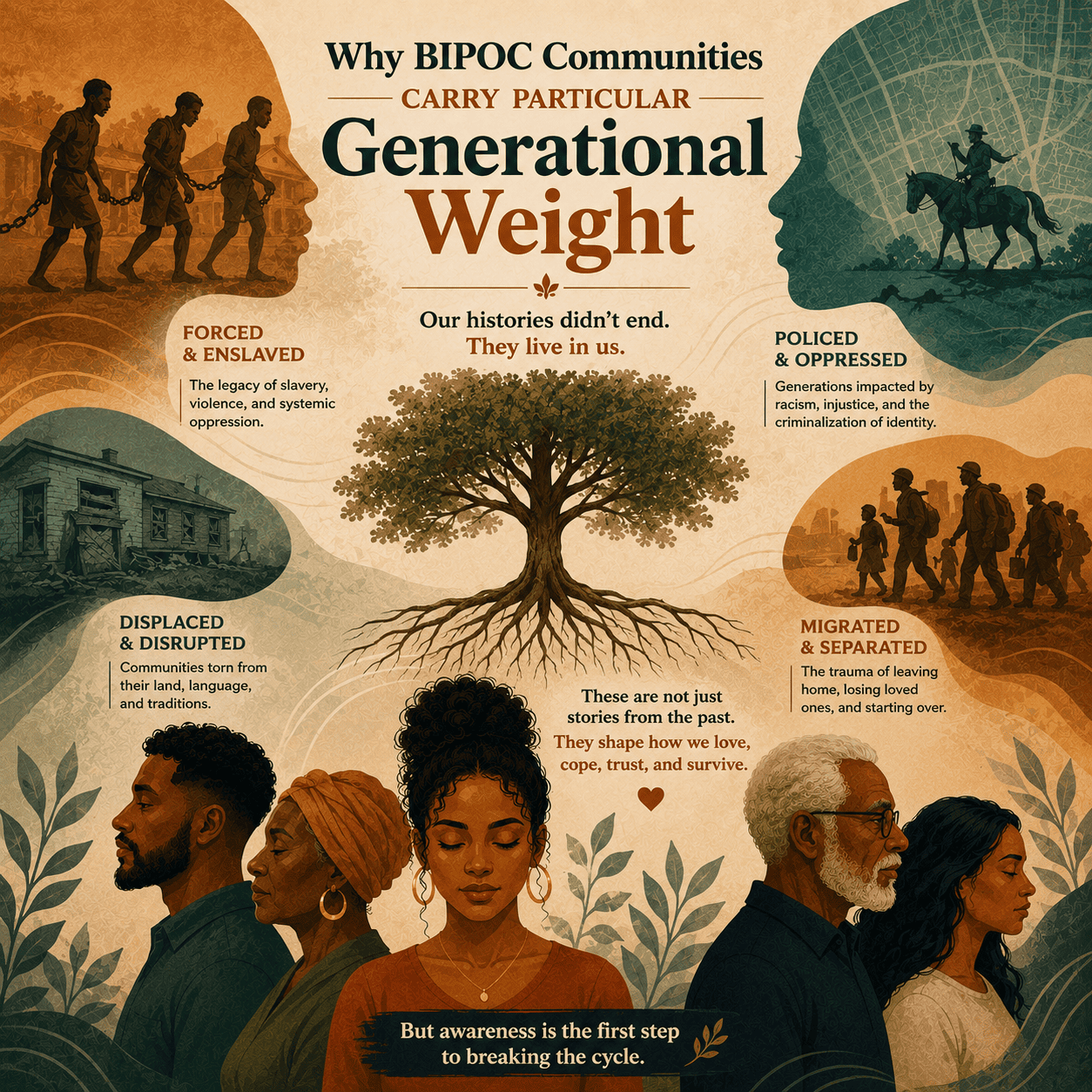
Why BIPOC Communities Carry Particular Generational Weight

Generational trauma is not exclusive to BIPOC communities – it can arise from any sustained, severe trauma. But the scope, duration, and systemic nature of the traumas embedded in the histories of Black, Indigenous, and People of Color communities create conditions for particularly deep and widespread intergenerational impact.

Generational Weight

For Black Americans, the generational weight includes the legacy of enslavement, reconstruction-era violence, Jim Crow laws, redlining, mass incarceration, and the ongoing experience of racial discrimination. For Indigenous communities, it encompasses the devastating effects of forced removal, the deliberate destruction of languages and cultural practices, the trauma of residential school systems, and the ongoing loss of land and sovereignty. For immigrant families across Latino, Asian, and other communities, it includes the trauma of displacement, persecution, separation from family and homeland, and the profound grief of cultural discontinuity.

These are not distant historical footnotes. They are living realities that shaped the grandparents who raised the parents who raised today’s adults. Their effects are present in how families communicate, how emotions are managed, how institutions are trusted or distrusted, and what it means to seek help.
How Generational Trauma Shows Up in Daily Life

Generational trauma rarely announces itself. It tends to surface in patterns that feel like personality or family culture rather than trauma symptoms. Some of the most common ways it manifests include:

Emotional Suppression and Avoidance

Families that survived by not showing weakness often pass down an implicit prohibition on emotional expression. Feelings are managed privately, if at all. Asking for help is framed as burden. Vulnerability is associated with danger rather than connection. Children raised in these environments often struggle to identify, articulate, or process their emotions as adults – not because they lack the capacity, but because the capacity was never developed or was actively discouraged.

Hypervigilance and Chronic Anxiety

Communities that have experienced sustained threat – from racial violence, persecution, poverty, or systemic instability – often develop a baseline state of alertness that serves as protection in genuinely dangerous environments. Passed down across generations, this hypervigilance can persist long after the immediate threat has receded, manifesting as chronic anxiety, difficulty relaxing, and a persistent sense that safety is temporary and precarious.

Distrust of Systems and Institutions

For communities whose encounters with healthcare, legal, educational, and governmental systems have historically resulted in harm rather than help, distrust is not irrational. It is well-earned. This distrust becomes embedded in family culture – and can create significant barriers to accessing mental health care, even when that care is needed and available.

Parentification and Role Reversal

In families navigating significant stress – economic, immigration-related, or trauma-related – children often take on adult emotional and practical responsibilities prematurely. This parentification can appear functional in the short term, but creates its own long-term consequences: difficulty allowing others to support you, chronic caretaking at the expense of self, and the deep, often unconscious belief that your needs come last.

Complicated Relationships With Identity and Culture

For families who survived colonization, assimilation pressure, or cultural erasure, the transmission of cultural identity across generations is itself complicated. Some families hold culture fiercely as a source of strength. Others have severed connection to cultural roots as a survival strategy – creating descendants who feel unmoored from their heritage without fully understanding why. Both responses are adaptive. Both can benefit from exploration in a culturally aware therapeutic context.

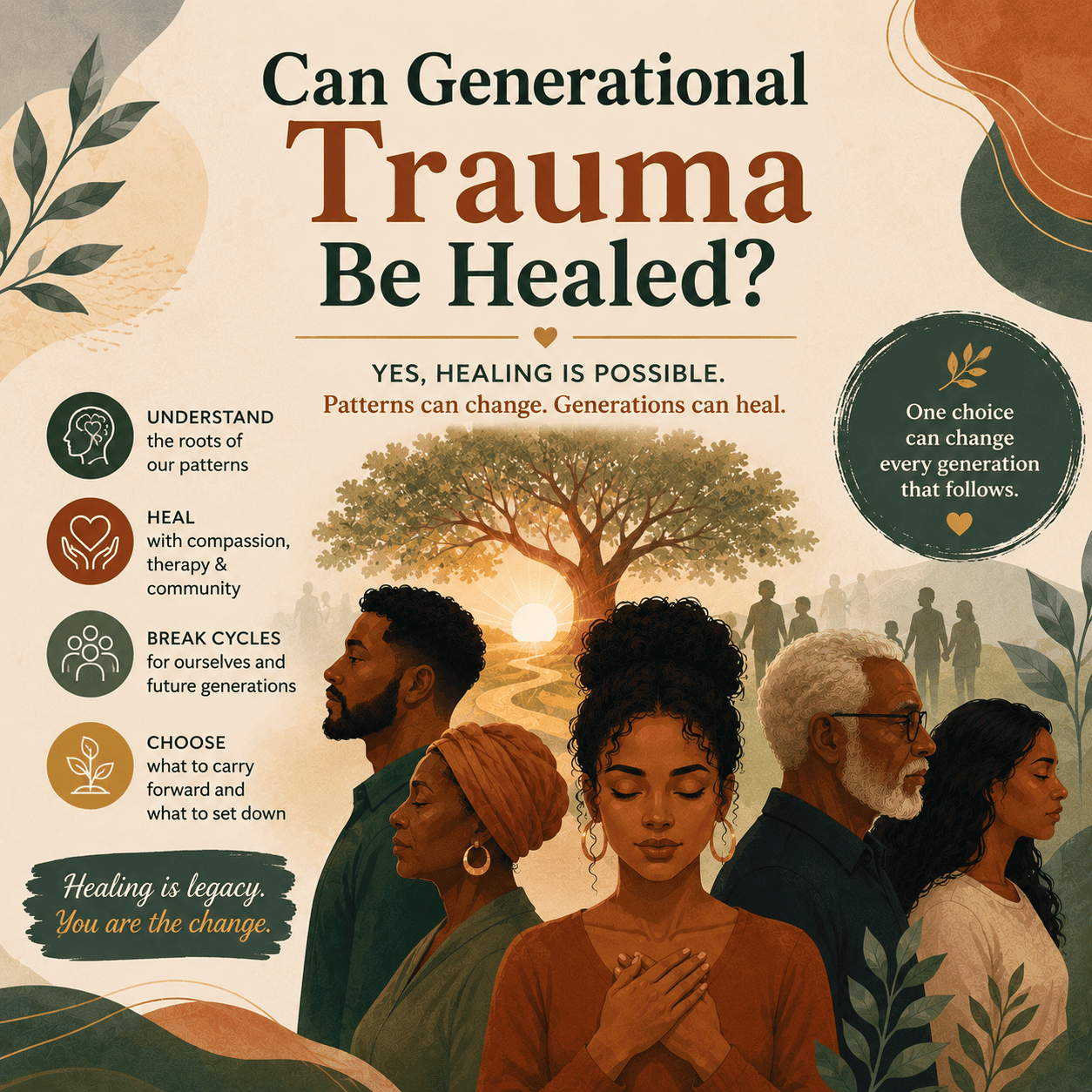
Can Generational Trauma Be Healed?

Yes – and this is one of the most important things to understand. Generational trauma is not a life sentence. It is a pattern, and patterns can change. The research on trauma-informed therapy, culturally competent care, and community healing is clear: intentional, sustained work can interrupt cycles that have persisted for generations.

Healing does not require erasing history or denying pain. It requires bringing what has been unconscious into consciousness – understanding the origins of patterns, grieving what was lost, and making deliberate choices about what to carry forward and what to set down. It is work that happens in therapy, in community, in family conversations, and in the quiet daily practice of responding differently than previous generations were equipped to.

The stakes are not only personal. A person who interrupts a generational trauma cycle changes the trajectory of every generation that follows. That is not a small thing.

Can Generational Trauma Be Healed

Where to Begin

Beginning the work of healing generational trauma starts with curiosity rather than judgment – about yourself, about your parents, about the conditions that shaped the people who shaped you. A culturally competent therapist can help you map these patterns, understand their origins, and develop practical tools for responding differently.

At The New Hope Mental Health Counseling Services, our licensed therapists work with BIPOC individuals and families navigating the complex terrain of generational trauma, cultural identity, racial stress, and inherited family patterns. We understand that healing in New York means healing in one of the most diverse and historically layered cities in the world – and that effective care must reflect that complexity. Whether you are searching for a mental health counselor in New York who understands BIPOC experiences, or looking for a mental health clinic in New York that offers trauma-informed, culturally aware care, we are here. Visit www.thenewhopemhcs.com to schedule a consultation.

The Bottom Line

Generational trauma is real, it is measurable, and it is treatable. The patterns your family passed down were almost always rooted in survival – in adaptations that made sense in the context of what your ancestors faced. Understanding that does not excuse harm. But it does make healing possible. And healing, when it comes, belongs to more than just you.

Generational Trauma - Your Questions Answered

Q1: What is the difference between generational trauma and regular trauma?

Regular trauma is the direct psychological impact of experiencing a distressing event. Generational trauma is the transmission of trauma’s effects – behavioral, emotional, and sometimes biological – to people who did not personally experience the original event. You can carry the psychological signature of your grandparent’s suffering without ever having lived through what they did, through learned family patterns, parenting behaviors, and epigenetic changes in stress response systems.

Q2: How do I know if I am experiencing generational trauma?

Common signs include chronic anxiety or hypervigilance without a clear present-day cause, difficulty trusting people or institutions, emotional suppression that feels deeply ingrained, patterns of caretaking at the expense of your own needs, a complicated relationship with your cultural identity, and recurring family dynamics that no one fully understands but everyone participates in. A trained therapist can help you identify whether these patterns have generational roots.

Q3: Can generational trauma actually be inherited biologically?

Research in epigenetics suggests yes – under certain conditions, the biological effects of severe trauma can produce heritable changes in how stress-response genes are expressed, without altering the DNA sequence itself. Studies on descendants of Holocaust survivors, enslaved people, and famine survivors have found measurable physiological differences that appear linked to ancestral trauma. The science is still developing, but the evidence is compelling enough to take seriously.

Q4: Is it possible to heal generational trauma if my family does not acknowledge it?

Yes. Healing does not require family consensus or even family participation. Individual therapy focused on understanding inherited patterns, processing grief, and developing new responses is effective regardless of whether other family members engage with the same work. You cannot change what happened to previous generations, but you can change how those events continue to live in your body, your choices, and your relationships.

Q5: What type of therapy is most effective for generational trauma?

Trauma-informed approaches with cultural competence are most effective. These include trauma-focused CBT, EMDR for processing trauma memories, Internal Family Systems therapy for understanding inherited family roles, and somatic approaches that address trauma stored in the body. The most important factor is a therapist who understands both the clinical and cultural dimensions of what you are working through. A mental health counselor in New York with specific experience in BIPOC and generational trauma is the ideal starting point.

Take the first step toward better mental health!

Fill the Below Form and Schedule a Clinical Consultation with us today→

Skip to content