
The New Hope MHCS

Finding a Multilingual, In-Network Therapist Who Understands Your Culture

Searching for the right mental health support can feel overwhelming even under the best circumstances. But for many people, there’s an added layer of difficulty: finding a therapist who not only takes their insurance, but who also speaks their language and genuinely understands their cultural background. If you’ve ever searched “therapist near me who speaks Spanish” or “counselor who takes my insurance,” you already know how narrow those results can feel.

Why Language Access Matters in Therapy

Therapy relies heavily on precise, nuanced communication – the specific words someone uses to describe an emotion, a memory, or a relationship often carry meaning that doesn’t translate directly between languages. When therapy happens through an interpreter, or worse, in a language the client is only partially comfortable in, something is often lost.

Clients working in their native language tend to access emotional material more fully and describe experiences with more accuracy and depth. This isn’t a minor convenience – it directly affects the quality and effectiveness of care. Someone processing grief, trauma, or family conflict deserves to do that work in the language that feels most natural to their inner experience, not the language that happens to be available.

Why Cultural Competence Goes Beyond Language

Speaking the same language is an important starting point, but cultural competence in therapy goes further. It means a clinician understands:

  • How mental health is discussed – or often not discussed – within a client’s cultural or familial context
  • The specific pressures tied to immigration, generational differences, or acculturation stress
  • Family structures and expectations that differ from a purely Western, individualistic therapy model
  • Religious or spiritual frameworks that shape how a client understands suffering, healing, and support
  • Historical and social factors – including discrimination or marginalization – that shape a client’s relationship to institutions, including healthcare

A therapist without this understanding may unintentionally pathologize normal cultural practices, misread family dynamics, or offer guidance that doesn’t actually fit the client’s real life and values. Culturally competent care means the therapeutic relationship starts from a place of accurate understanding rather than assumption.
The Insurance Barrier

Even when someone finds a therapist who feels like the right cultural and linguistic fit, cost remains one of the biggest barriers to consistent mental health care. Many therapists don’t accept insurance at all, and out-of-pocket rates in New York can be prohibitively expensive for ongoing weekly sessions. This forces many people to choose between financial stability and consistent care – a choice no one should have to make.

Finding a mental health clinic in New York with broad insurance acceptance changes this equation significantly, making sustained, quality care realistic rather than a financial stretch reserved for a privileged few.


Check the list of Insurance plans we accept in New York.

What This Looks Like in Practice

Consider a few common scenarios that illustrate why this combination – language, cultural fit, and insurance access – matters so much:

A father who immigrated to Queens twenty years ago is more comfortable expressing complex emotions in his native language than in English, and needs a therapist who can meet him there rather than requiring him to translate his inner world in real time.

A young woman navigating conflict between her family’s cultural expectations and her own individual goals needs a therapist who understands that this tension isn’t dysfunction – it’s a genuinely common experience for people balancing two cultural frameworks, and it deserves nuanced, non-judgmental support.

A grandmother on a fixed income in Nassau County needs consistent grief counseling after losing her spouse, but can only realistically continue treatment if her insurance is accepted without financial strain forcing her to stop after a few sessions.

Each of these situations requires more than “a good therapist” in the abstract – they require the right combination of accessibility, language, and cultural understanding.

What to Look for When Searching

Affirming care for non-binary clients is not complicated in principle, though it does require deliberate practice and ongoing learning. The foundational elements include:

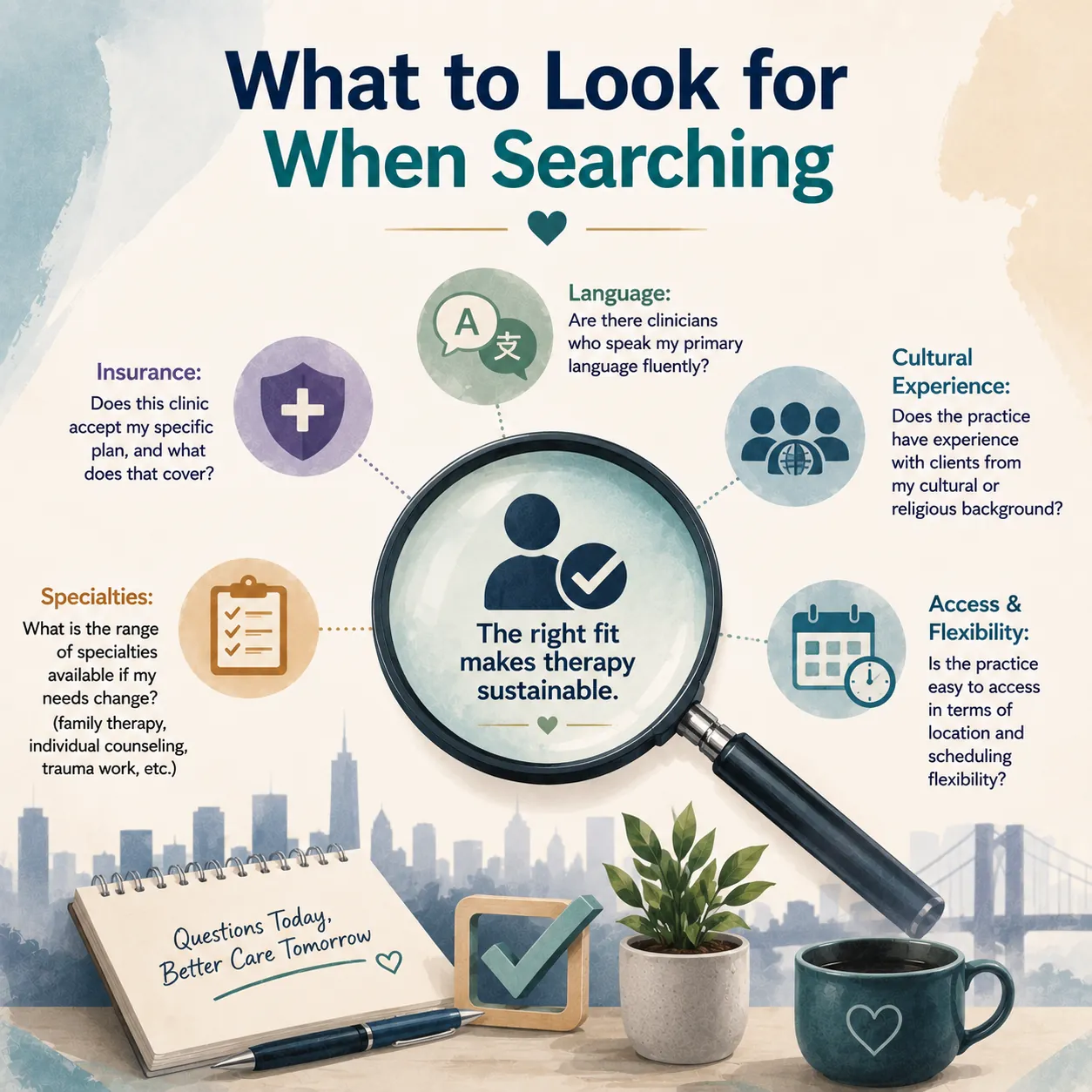
When you’re searching for a mental health counselor in New York, consider asking directly:

  • Does this clinic accept my specific insurance plan, and what does that cover?
  • Are there clinicians who speak my primary language fluently, not just conversationally?
  • Does the practice have experience with clients from my cultural or religious background specifically?
  • What is the range of specialties available, in case my needs shift over time (family therapy, individual counseling, trauma work, etc.)?
  • Is the practice easy to access from where I live and work, in terms of both location and scheduling flexibility?

These aren’t small details – they determine whether therapy is something you can realistically sustain long enough to see real benefit, or something you start and stop because the fit or the logistics don’t work.

multilingual therapist new york

A Practice Built Around These Realities

This is precisely the gap The New Hope Mental Health Counseling Services was built to close. As a multicultural mental health clinic in New York, our clinicians speak seven languages between them and the practice accepts more than 40 different insurance plans, specifically to remove the barriers that often stand between people and consistent, high-quality care. Our team includes clinicians with lived and professional experience across a wide range of cultural backgrounds, offering therapy for anger management, trauma, family and marriage counseling, parenting support, and mood disorders – all delivered with genuine cultural understanding, not a one-size-fits-all approach.

Serving Queens, Long Island, and Nassau County, our goal is simple: make sure that language, cost, or cultural mismatch never stand between someone and the care they need. If you’ve struggled to find a therapist who truly understands your background and fits your financial reality, that search may be easier than you think.

How to find Multilingual Mental Health Clinic in New York - Your Questions Answered (FAQs)

Why does it matter if a therapist speaks my native language?

Therapy relies on precise emotional language, and clients often communicate more fully and accurately in their native language, making language match a meaningful factor in the quality and effectiveness of care.

What does "culturally competent" therapy actually mean?

It means a therapist understands the client’s cultural context around family, religion, immigration, and mental health stigma, and avoids misreading normal cultural practices as dysfunction.

How many insurance plans does The New Hope Mental Health Counseling Services accept?

We accepts more than 40 different insurance plans, making consistent, ongoing care more financially accessible for clients across Queens, Long Island, and Nassau County.

What languages are available for therapy at this practice?

Clinicians at The New Hope Mental Health Counseling Services collectively speak seven languages, allowing clients to receive care in the language they’re most comfortable expressing themselves in.

What questions should I ask when searching for a mental health clinic in New York?

Ask whether your specific insurance is accepted, whether clinicians speak your language fluently, whether the practice has experience with your cultural background, and what range of specialties is available.

Take the first step toward better mental health!

Fill the Below Form and Schedule a Clinical Consultation with us today→

Skip to content