

The New Hope MHCS

OCD Awareness Week: Understanding OCD Beyond “Being Organized”

You wash your hands.
Then you wonder whether you washed them properly.
So you wash them again.

You check the lock before leaving home. You walk halfway down the street and wonder whether you really locked it. You go back. You check.

For some people, obsessive-compulsive disorder is not about being especially neat or particular.
It is about getting caught in a loop.

A thought creates fear or uncertainty. The fear creates an urge to do something. The action brings temporary relief. Then the doubt returns.
Again.
And again.

OCD Awareness Week takes place October 12 through October 18, 2026, according to Mental Health America’s 2026 awareness calendar.

It is an opportunity to clear up one of the most common misunderstandings about obsessive-compulsive disorder.

OCD is not simply liking things organized.

What is OCD?

Obsessive-compulsive disorder is a mental health condition involving obsessions, compulsions, or both.

Obsessions are unwanted, recurring thoughts, urges, or mental images that can create significant distress.

Compulsions are repetitive behaviors or mental acts that a person feels driven to perform, often in response to an obsession or an uncomfortable sense of uncertainty.

The behavior may bring relief for a moment.

But the relief does not last.

NIMH describes OCD as a condition in which unwanted thoughts and repetitive behaviors can become difficult to control and interfere with daily life.

OCD Is More Than Being Neat

OCD is more than being neat

Someone who enjoys an organized desk can put things away because they like the way the room looks.

Someone with OCD may feel that something terrible could happen unless an action is performed in a particular way.

Those experiences are not the same.

OCD can involve fears about contamination, harm, mistakes, responsibility, morality, relationships, or other themes. Some people experience intrusive thoughts that are deeply disturbing or completely inconsistent with their values.

The thought itself can become frightening.

“I had this thought. What does that say about me?”
That question can become part of the cycle.
Compulsions are not always visible

This is something many people do not realize.

A compulsion does not have to involve washing, checking, counting, or arranging objects.

Some compulsions happen almost entirely inside the mind.

A person may repeatedly replay a conversation, mentally review whether they said something wrong, seek reassurance, compare feelings, analyze memories, or attempt to “cancel out” an unwanted thought.

From the outside, they may look completely calm.

Inside, their mind may be working overtime.

This is one reason OCD can remain hidden for years.

Why reassurance can become part of the cycle

Imagine you are terrified that you accidentally hurt someone.

You ask your partner, “I didn’t do anything wrong, right?”

They reassure you.

For a little while, you feel better.

Then the doubt returns.

You ask again.

The relief comes again.

Eventually, reassurance itself can become part of the pattern.

This does not mean loved ones should never offer comfort. It means that when reassurance becomes repetitive and necessary to reduce anxiety, it may be worth discussing the pattern with a mental health professional.

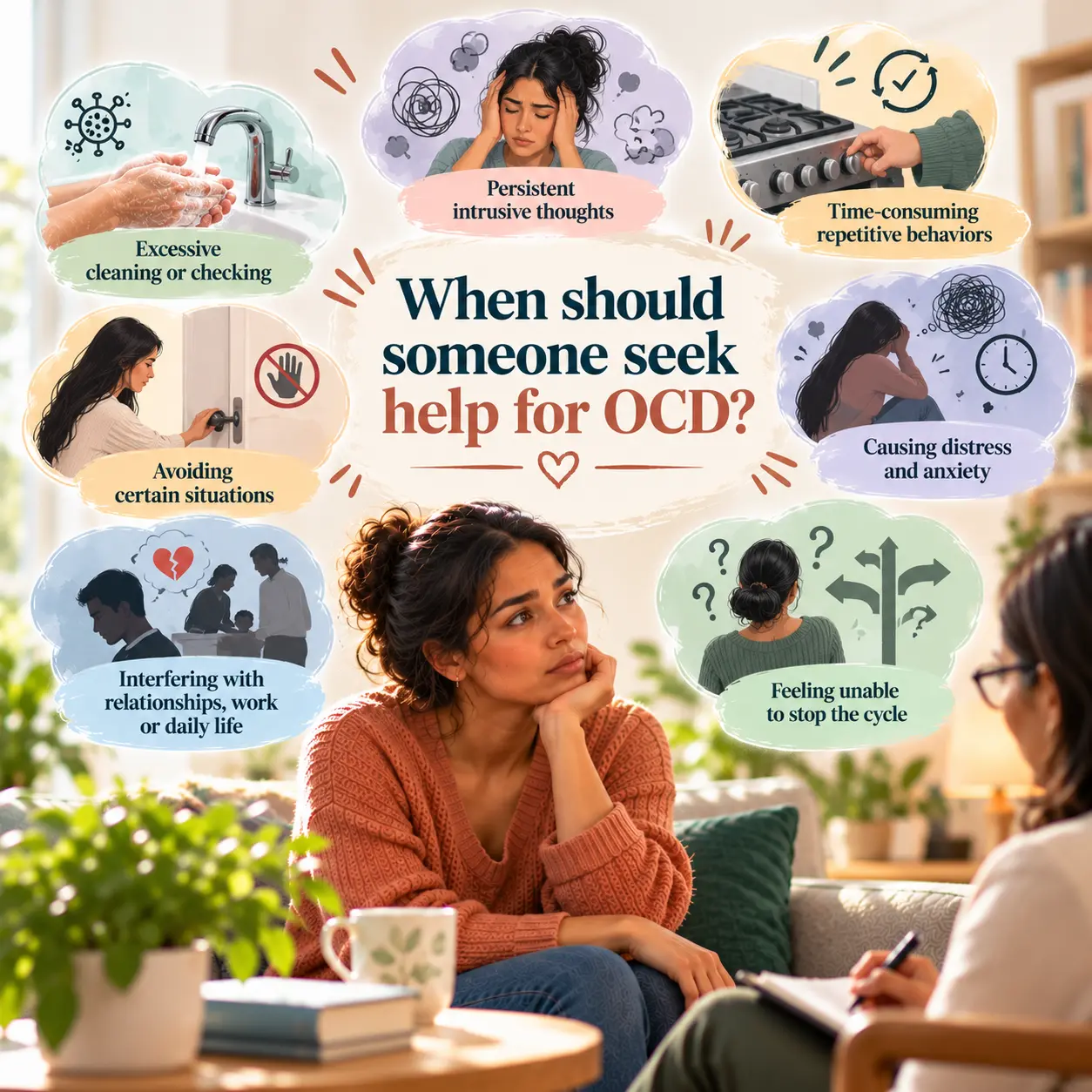
When should someone seek help for OCD?

The key question is not whether you occasionally have unwanted thoughts.

Most people experience strange, uncomfortable, or intrusive thoughts at times.

The concern is when obsessions and compulsions become persistent, distressing, time-consuming, or disruptive to everyday life.

  • Maybe you are spending so much time checking that you are late for work.
  • Maybe you avoid touching ordinary objects because of contamination fears.
  • Maybe intrusive thoughts are making intimacy, parenting, religion, relationships, or daily routines extremely difficult.

You may know that your fears feel excessive and still feel unable to stop the cycle.

That is not a personal failure.


It is a reason to seek appropriate support.

When Should Someone Seek OCD Help_

Can OCD be treated?

Yes.

Treatment can help people manage OCD symptoms and reduce their impact on daily life.

NIMH identifies psychotherapy, medication, or a combination of the two as treatment options. Cognitive behavioral therapy and a specialized approach called exposure and response prevention, or ERP, are among the psychotherapies used for OCD.

ERP involves gradually facing situations connected with obsessive fears while learning not to rely on compulsive responses.

This is done in a structured therapeutic setting.

It can feel uncomfortable. Treatment is not about forcing someone into situations without support.

A qualified mental health professional can help determine whether ERP or another approach is appropriate.

Finding OCD therapy in New York

If you are searching for an OCD therapist in New York or a mental health counselor in New York, it is reasonable to ask about experience treating OCD specifically.

You can ask:

  • Have you worked with OCD before?
  • Are you familiar with ERP?
  • How do you approach intrusive thoughts?
  • What happens during an initial assessment?

These questions can help you understand whether the clinician’s approach matches what you need.

You do not have to disclose every intrusive thought during your first phone call.

You can start by saying, “I’m experiencing repetitive thoughts and behaviors that are interfering with my life, and I would like to understand whether therapy could help.”
That is enough.

Therapy should make room for the person behind the OCD

OCD can consume attention.

Appointments, relationships, work, family time, sleep, and ordinary routines can all become organized around avoiding anxiety.

But you are more than the thoughts that frighten you.

At The New Hope Mental Health Counseling Services, therapy can provide a space to discuss obsessive thoughts, compulsive behaviors, anxiety, relationships, and the impact these patterns have on everyday life.

For someone searching for a mental health clinic in New York, finding a clinician who understands OCD can be an important part of getting appropriate care.

You do not have to wait until the rituals take over everything.

And you do not have to be completely certain that what you are experiencing is OCD before asking for help.
You can simply start with what is happening.

OCD Awareness Week - Your Questions Answered (FAQs)

Q1. What is OCD?

OCD is a mental health condition involving obsessions, compulsions, or both. These experiences can become distressing and interfere with everyday activities.

Q2. Is OCD just about cleanliness and organization?

No. OCD can involve many different themes, including contamination, harm, checking, responsibility, intrusive thoughts, and other fears. Compulsions may also happen mentally rather than through visible behaviors.

Q3. What is ERP therapy for OCD?

Exposure and response prevention is a form of cognitive behavioral therapy in which a person gradually encounters situations that trigger obsessive fears while learning to resist the compulsive response.

Q4. Can OCD be treated without medication?

Psychotherapy can be an effective treatment for OCD. Depending on the individual, psychotherapy, medication, or a combination may be considered. A qualified professional can discuss appropriate options.

Q5. How can I find an OCD therapist in New York?

Look for a licensed mental health professional with specific experience treating OCD and ask whether they use evidence-based approaches such as CBT or ERP.

Take the first step toward better mental health!

Fill the Below Form and Schedule a Clinical Consultation with us today→

Skip to content