
The New Hope MHCS

Back-to-School Anxiety - Helping Your Child (and Yourself) Transition

The end of summer brings new backpacks, school supply lists, and for many families, a wave of anxiety that catches parents off guard. Back-to-school anxiety is incredibly common, affecting children of nearly every age, and it often shows up in ways parents don’t immediately recognize as anxiety at all.

What Back-to-School Anxiety Actually Looks Like

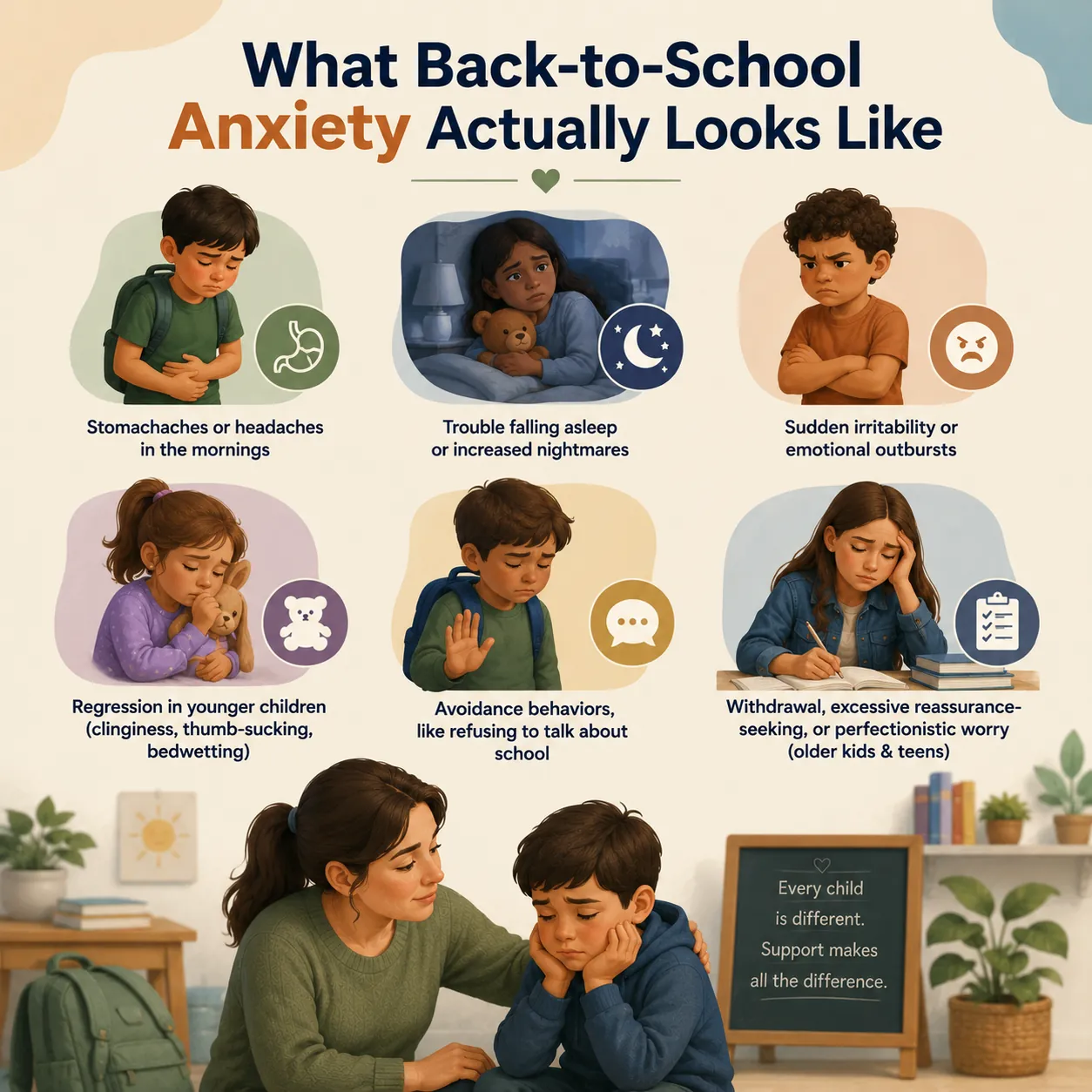
Child showing signs of anxiety before school, stomachache and worry

It rarely announces itself directly. Instead, it tends to appear as:

  • Stomachaches or headaches in the mornings leading up to school, with no clear medical cause
  • Trouble falling asleep or increased nightmares
  • Sudden irritability or emotional outbursts over small things
  • Regression in younger children – clinginess, thumb-sucking, bedwetting after being previously potty-trained
  • Avoidance behaviors, like refusing to talk about school or getting upset when the topic comes up
  • In older kids and teens, withdrawal, excessive reassurance-seeking, or perfectionistic worry about grades and social standing

Every child’s anxiety looks a little different, and it can shift with age – a five-year-old’s separation anxiety looks nothing like a fourteen-year-old’s social anxiety, even though the underlying nervous system response is similar.

Why Transitions Are Hard on the Developing Brain

Children’s brains, particularly the prefrontal cortex responsible for regulating emotion and managing uncertainty, are still developing well into their twenties. A new school year involves an enormous amount of uncertainty at once: new teachers, new classmates, new schedules, new expectations. For a brain that’s still learning how to manage unpredictability, that’s a lot to process – even for kids who seem outwardly confident.

This is worth remembering because it reframes the anxiety as developmentally normal rather than a sign that something is wrong with your child. The goal isn’t to eliminate the anxiety completely – some nervousness before a big transition is healthy and adaptive – but to help your child build tools to move through it.

Practical Strategies That Actually Help

  1. Normalize the feeling without dismissing it.
    Saying “there’s nothing to worry about” can unintentionally make a child feel unheard. Instead, try: “It makes sense to feel nervous about new things – a lot of kids do. Let’s figure out what might help.” This validates the emotion while still moving toward a solution.
  1. Rebuild routine gradually before the first day.
    If summer sleep schedules have drifted, shift bedtimes and wake times back gradually over one to two weeks rather than all at once. Predictable routines reduce the number of unknowns a child’s nervous system has to manage on day one.
  1. Do a low-stakes preview.
    If possible, visit the school building, walk the route, or look at photos of the new classroom together. Familiarity – even secondhand familiarity – reduces anticipatory anxiety significantly.
  1. Give language to physical sensations.
    Teach children to name what they’re feeling in their body (“my stomach feels tight” or “my chest feels fast”) and connect it to the word “nervous.” This builds the foundation for emotional regulation skills they’ll use for the rest of their lives.
  1. Practice a simple calming skill together.
    Slow breathing (in for four counts, out for six), a grounding exercise, or a comfort object for younger kids can give children something concrete to reach for in anxious moments, rather than feeling at the mercy of the feeling.
  1. Watch your own reaction.
    Children are remarkably attuned to parental stress. If a parent is visibly anxious about the transition – worried about drop-off, anxious about performance, stressed about logistics – kids often absorb that anxiety as confirmation that something is genuinely wrong. Managing your own nervous system during this season isn’t selfish; it directly supports your child’s regulation too.

When It's More Than Typical Nerves

Some anxiety around a new school year is expected and usually eases within the first few weeks as routines settle in. But it’s worth seeking additional support if you notice:

  • Anxiety that doesn’t improve after several weeks of school
  • Physical symptoms severe enough to interfere with attending school regularly
  • Panic-like symptoms (racing heart, difficulty breathing, intense fear) around school
  • Persistent sleep disruption
  • Signs of depression alongside the anxiety – withdrawal, loss of interest in things they used to enjoy, changes in appetite

These signs don’t mean you’ve done anything wrong as a parent. They mean your child could benefit from additional support to build coping skills beyond what’s manageable at home alone.

practical strategies back to school

You Don't Have to Navigate This Alone

Parents carry their own version of this transition too – worry about whether their child will adjust, guilt about balancing work schedules with drop-offs and pickups, and the general stress of a household schedule shifting all at once. It’s common for parents to underestimate how much their own stress during this season affects the whole family system.

If back-to-school anxiety is significantly affecting your child, or if you’re finding your own stress harder to manage this season, working with a mental health counselor in New York who specializes in child and family therapy can make a meaningful difference. The New Hope Mental Health Counseling Services, a multicultural mental health clinic in New York serving families across Queens, Long Island, and Nassau County, offers parenting guidance and individual and family counseling designed to help both children and parents move through seasonal transitions with more ease.

Back-to-school anxiety is common, manageable, and – with the right support – often becomes an opportunity for your child to build lifelong coping skills, not just a hurdle to get through.

Back-to-school Anxiety - Your Questions Answered (FAQs)

Q1. What are the most common signs of back-to-school anxiety in kids?

Common signs include stomachaches or headaches without medical cause, trouble sleeping, irritability, clinginess or regression in younger children, and withdrawal or reassurance-seeking in older kids and teens.

Q2. Is some back-to-school anxiety normal?

Yes. Mild anxiety around a major transition is developmentally normal and often resolves within the first few weeks as new routines become familiar.

Q3. How can parents help reduce their child's anxiety before school starts?

Rebuilding sleep routines gradually, previewing the school environment, validating feelings without dismissing them, and practicing simple calming skills together can all meaningfully reduce anticipatory anxiety.

Q4. When should back-to-school anxiety be evaluated by a professional?

If anxiety doesn’t improve after several weeks, causes school avoidance, includes panic-like symptoms, or appears alongside signs of depression, it’s worth consulting a mental health professional.

Q5. Does parental stress affect a child's back-to-school anxiety?

Yes. Children are highly attuned to parental emotional states, and visible parental stress during transitions can reinforce a child’s own anxiety, making parental self-regulation an important part of supporting kids through this season.

Take the first step toward better mental health!

Fill the Below Form and Schedule a Clinical Consultation with us today→

Skip to content