The New Hope MHCS

BIPOC Mental Health Month — Why Race, Culture, and Mental Health Are Impossible to Separate

Mental health does not exist in a vacuum. It is shaped by history, community, family, economics, and the social environment a person navigates every single day. For Black, Indigenous, and People of Color – communities that have historically faced and continue to face systemic inequity, discrimination, and cultural erasure – these forces carry particular weight. They do not sit alongside mental health. They are inseparable from it.

July is Bebe Moore Campbell National Minority Mental Health Awareness Month, named in honor of the author, educator, and tireless advocate who dedicated her life to dismantling the silence around mental health in communities of color. Campbell understood something that mainstream mental health conversations have often missed: that you cannot address a person’s mental health without understanding the world they live in. This month, that understanding is the foundation.

Who Was Bebe Moore Campbell and Why Does She Matter?

Bebe Moore Campbell was an American author, journalist, and mental health advocate who co-founded the National Alliance on Mental Illness (NAMI) Urban Los Angeles chapter. She wrote openly and powerfully about mental illness – including in her novel 72 Hour Hold, which explored a mother’s journey with a daughter experiencing bipolar disorder – at a time when such conversations in Black communities were almost entirely absent from public life.

Campbell recognized that for many BIPOC communities, mental health stigma was not just personal. It was cultural and historical – rooted in generations of being told that asking for help was weakness, that community should handle everything internally, and that accessing mainstream mental health systems was neither safe nor relevant. She worked to change that until her death in 2006. Congress formally recognized this month in her honor in 2008.

The Mental Health Disparities Facing BIPOC Communities

The mental health inequities facing Black, Indigenous, and People of Color are substantial, well-documented, and rooted in identifiable systemic causes. Understanding them is not about framing BIPOC communities as damaged or fragile. It is about naming the structural realities that create unequal mental health outcomes – and that demand structural responses.

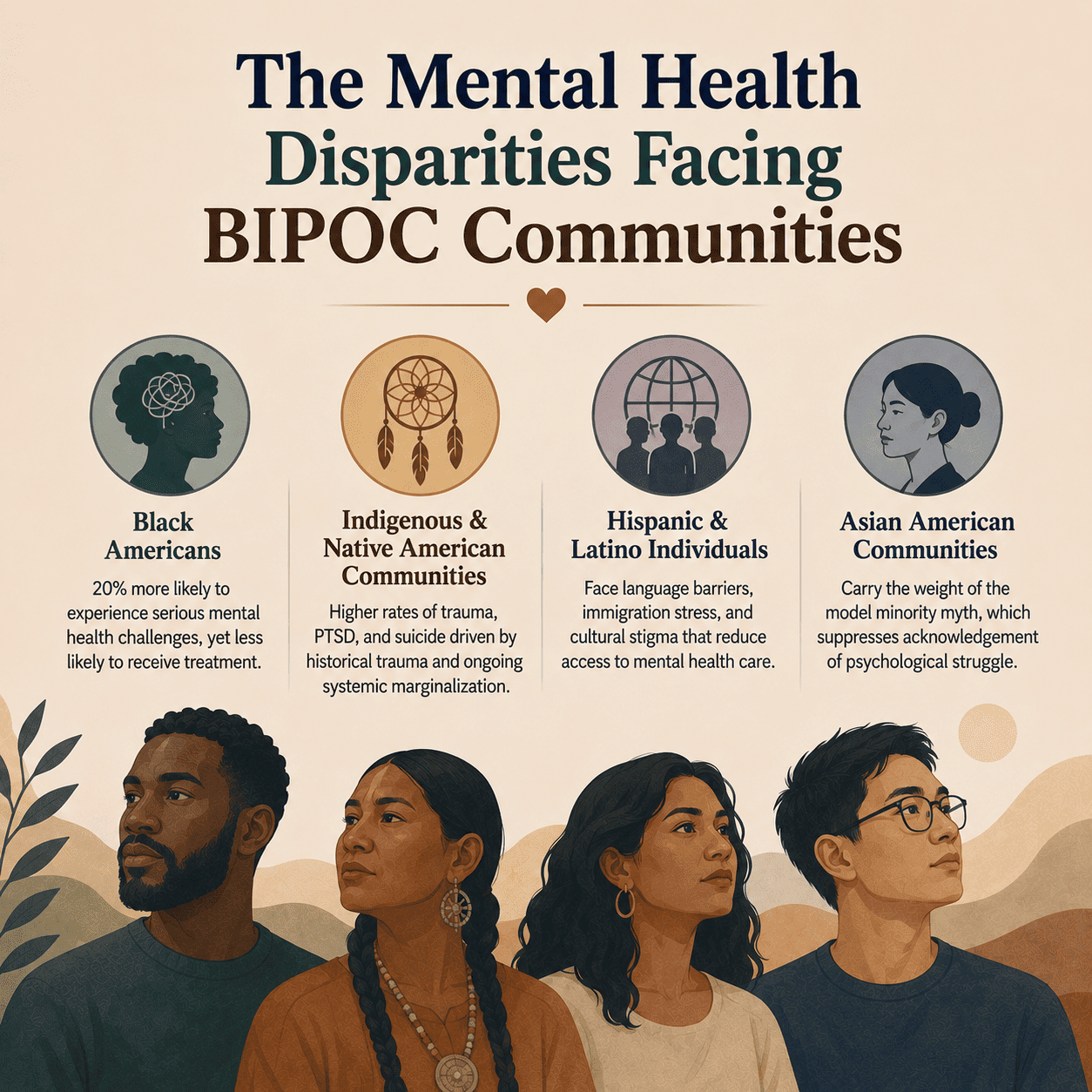
The Mental Health Disparities Facing BIPOC Communities

Black Americans are 20 percent more likely to experience serious mental health challenges than the general population, yet significantly less likely to receive treatment.
Indigenous and Native American communities experience rates of trauma, PTSD, and suicide that far exceed national averages, driven by the compounding effects of historical trauma, land displacement, and ongoing systemic marginalization. Hispanic and Latino individuals often face language barriers, immigration-related stress, and cultural stigma that dramatically reduce mental health help-seeking. Asian American communities carry the weight of the model minority myth – a cultural expectation of silent resilience that actively suppresses acknowledgment of psychological struggle.

These are not coincidences. They are the predictable outcomes of systems that were not designed with BIPOC communities in mind – and in many cases were designed to actively work against them.
Why Cultural Context Cannot Be Separated From Mental Health

For BIPOC individuals, mental health cannot be meaningfully addressed without accounting for cultural identity. Culture shapes how distress is expressed, what is considered appropriate to share and with whom, what healing is believed to look like, and whether seeking help from a professional feels like an act of self-care or a betrayal of community values.

In many cultures, mental health struggles are discussed through a spiritual or communal framework rather than a clinical one. Emotional difficulty may be addressed through faith, family, or traditional practices – all of which have genuine value – but which can also delay or replace professional care when that care is what is clinically needed. Neither the cultural framework nor the clinical one is wrong. What matters is having access to care that honors both.

This is what culturally competent mental health care looks like in practice: a therapist who does not require a BIPOC client to explain the basics of their cultural experience, who understands the role of historical trauma in present-day symptoms, who does not pathologize cultural expressions of distress, and who creates a clinical space that feels genuinely safe rather than merely neutral.

The Role of Racial Trauma in Mental Health

Racial trauma – the psychological harm caused by experiences of racism, discrimination, and racially motivated violence – is a clinical reality that has only recently begun receiving the mainstream recognition it deserves. It is not hypersensitivity. It is not a political position. It is the measurable mental health impact of living in a body that has been historically targeted and continues to be profiled, stereotyped, or threatened.

Racial trauma can present similarly to PTSD: hypervigilance in certain environments, intrusive thoughts following discriminatory incidents, emotional numbing as a protective response, and difficulty trusting systems or individuals associated with past harm. It accumulates over a lifetime, is often invisible to those who have not experienced it, and requires a therapist who has the training and cultural awareness to recognize and address it appropriately.

For many BIPOC individuals, racial trauma is not a past event. It is an ongoing experience – renewed each time a discriminatory encounter occurs, each time a news story brings collective pain, each time a system fails in ways that feel familiar. Effective care holds this reality rather than minimizing it.

Barriers to Mental Health Care in BIPOC Communities

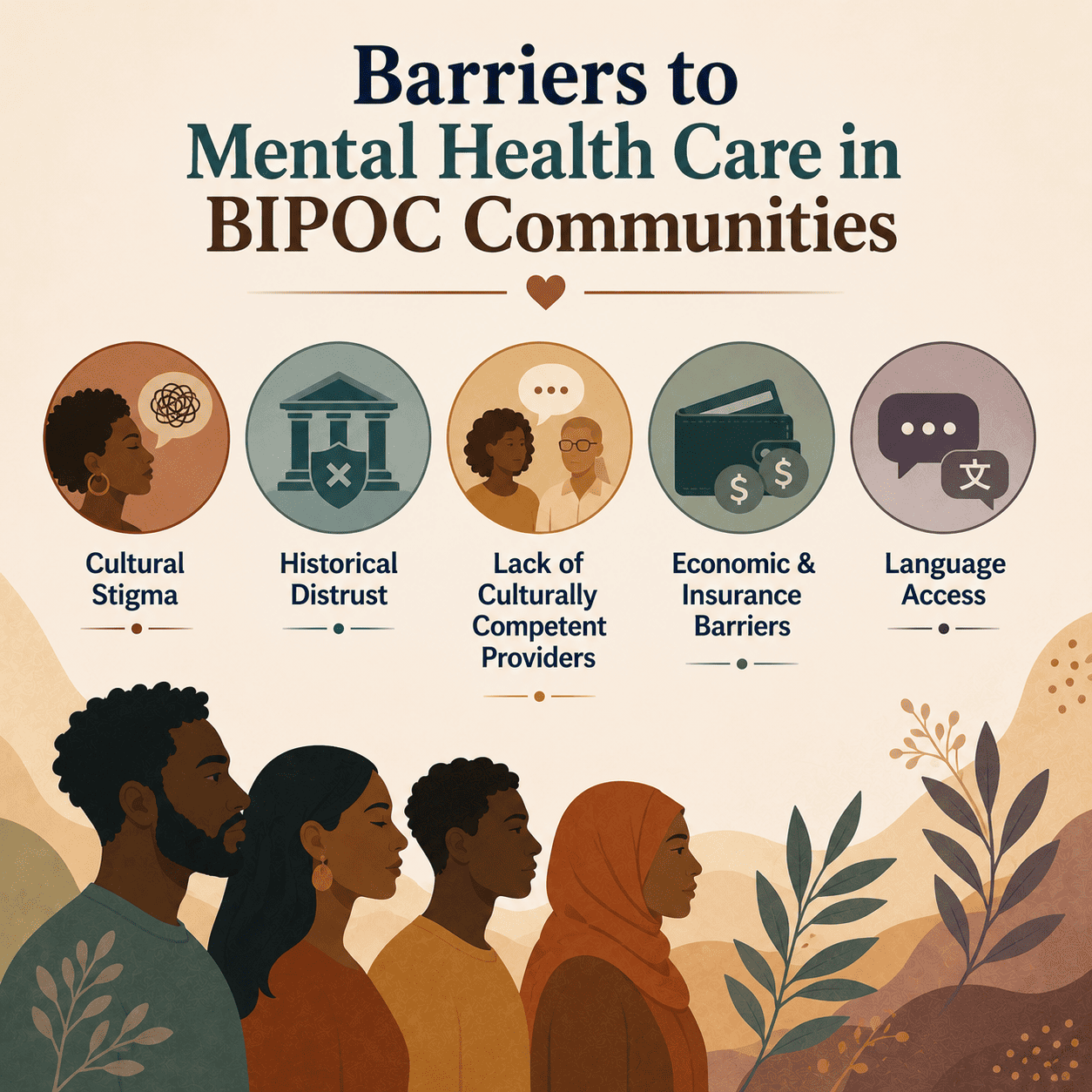
Access to mental health care in BIPOC communities is blocked by multiple interconnected barriers:

Cultural stigma: In many communities of color, mental health struggles are viewed as a private family matter or a spiritual failing. Seeking outside help can carry social consequences or feel like abandoning community values.

Historical distrust of healthcare systems: For Black Americans in particular, the history of medical experimentation, exploitation, and neglect creates entirely rational reluctance to engage with healthcare systems that have not always acted in their interests.

Lack of culturally competent providers: The mental health workforce remains overwhelmingly white. BIPOC clients who want a therapist who shares their background or genuinely understands their cultural experience face a significantly limited pool of providers.

Economic and insurance barriers: BIPOC communities experience higher rates of poverty and are more likely to be uninsured or underinsured, making the already high cost of mental health care even more prohibitive.

Barriers to Mental Health Care in BIPOC Communities

Language access: For communities where English is not the primary language, the scarcity of multilingual mental health providers creates a significant barrier that is often insurmountable without dedicated effort from the healthcare system.

What This Month Calls For

BIPOC Mental Health Month is not simply a moment to raise awareness. It is an invitation to act – in ways that are specific, honest, and sustained. For mental health organizations and providers, it means actively examining how their services are or are not accessible, culturally relevant, and representative. For communities, it means continuing to dismantle the internal stigma that prevents people from reaching out. For individuals, it means recognizing that help-seeking is not weakness – it is, in fact, one of the most culturally resonant forms of strength, because it is rooted in the commitment to show up fully for oneself and for those who depend on you.

At The New Hope Mental Health Counseling Services, we are committed to providing culturally aware, compassionate, and accessible care for BIPOC individuals and families navigating depression, anxiety, trauma, racial stress, and the full range of mental health challenges. Our team of licensed mental health counselors in New York understands that your cultural identity is not incidental to your mental health – it is central to it. As a trusted mental health clinic in New York serving one of the most diverse cities in the world, we welcome every background, every story, and every step toward healing. Visit www.thenewhopemhcs.com to learn more or to schedule a consultation.

The Bottom Line

Race, culture, and mental health are not separate conversations. They have never been. BIPOC Mental Health Month is a reminder that healing must be rooted in the full truth of who a person is – including where they come from, what they have carried, and what the world has asked them to endure. That truth is not a complication. It is the starting point.

BIPOC Mental Health - Your Questions Answered

Q1: Why do BIPOC communities have higher rates of mental health challenges?

The higher rates of depression, anxiety, and trauma-related conditions in BIPOC communities are not inherent to race or ethnicity. They are the result of chronic, cumulative stress produced by systemic racism, historical trauma, economic inequality, and the ongoing experience of discrimination. Researchers call this minority stress, and its mental health consequences are well-documented. The conditions are the system’s failure – not the community’s.

Q2: What is racial trauma and how does it affect mental health?

Racial trauma refers to the psychological harm caused by experiencing or witnessing racism, discrimination, or racially motivated violence. It can present similarly to PTSD – hypervigilance, intrusive thoughts, emotional numbing, and difficulty trusting environments associated with past harm. For many BIPOC individuals, racial trauma is ongoing rather than a single past event, which makes it both more persistent and more complex to treat without a culturally aware clinician.

Q3: Why don't more BIPOC individuals seek mental health treatment?

Multiple interconnected barriers prevent BIPOC communities from accessing care: cultural stigma that frames mental health struggles as private or spiritual matters, a justified historical distrust of healthcare systems that have not always acted in BIPOC interests, a mental health workforce that remains largely non-representative, and economic barriers including lack of insurance. These are systemic obstacles – not personal failures – and they require systemic as well as individual solutions.

Q4: What does culturally competent mental health care actually look like?

Culturally competent care means a therapist who does not require you to explain the basics of your cultural background, who understands how historical trauma shapes present-day symptoms, who does not pathologize cultural expressions of distress, and who has actively sought training in working with diverse communities. It means a clinical environment where your identity is not set aside to focus on your symptoms – because the two cannot be meaningfully separated.

Q5: How do I find a culturally competent therapist in New York?

Start by asking directly about a therapist’s experience with BIPOC clients and their training in cultural competence and racial trauma. Online directories including Psychology Today and Therapy for Black Girls allow filtering by cultural background and specialty. NAMI’s resource hub and local community organizations can also provide vetted referrals. At New Hope Mental Health Counseling Services, our mental health counselors in New York provide culturally aware care for BIPOC individuals and families. Visit www.thenewhopemhcs.com to learn more.

Take the first step toward better mental health!

Fill the Below Form and Schedule a Clinical Consultation with us today→

Skip to content