
The New Hope MHCS

Loneliness Is a Mental Health Crisis - And Most People Don't Even Recognize It

You can be surrounded by people and still feel completely alone. You can have hundreds of social media connections, a full calendar, a job that keeps you constantly occupied – and still go to bed each night with a persistent, hollow ache that nothing seems to reach.

That experience has a name. It is loneliness. And it is one of the most significant and most underestimated mental health challenges of our time.

Loneliness Awareness Week, observed June 15 to 21 each year, exists to bring this hidden experience into the open – not to manufacture guilt about connection, but to help people recognize loneliness for what it is: a fundamental human need going unmet. And to understand that addressing it is not a luxury. It is a health imperative.

What Is the Difference Between Loneliness and Being Alone?

Loneliness is one of the most commonly misunderstood experiences in mental health, and that misunderstanding keeps many people from recognizing it in themselves.

Being alone and loneliness are not the same thing. Solitude – time spent in one’s own company by choice – can be deeply restorative and is associated with creativity, reflection, and wellbeing. Loneliness is the subjective experience of feeling disconnected, unseen, or lacking the meaningful relationships one desires. It is defined not by how many people are in your life, but by the quality and depth of connection with them.

Loneliness is not a personality trait. It is not what introverts feel by default, or what socially anxious people simply have to accept. It is a signal – like hunger or thirst – that a fundamental human need is not being adequately met. And like hunger and thirst, it has serious consequences when left unaddressed for long periods.

Is Loneliness a Mental Health Condition?

Loneliness is not classified as a standalone mental health disorder – but its effects on mental and physical health are so significant that the distinction matters less than it might seem. The U.S. Surgeon General issued an advisory in 2023 declaring loneliness a national public health epidemic. The advisory noted that chronic loneliness carries health consequences comparable to smoking fifteen cigarettes a day.

About half of American adults report measurable levels of loneliness. Young adults between the ages of 18 and 25 are among the loneliest demographic – a counterintuitive finding given the common assumption that social connection peaks in youth. Social media, widely expected to reduce loneliness by expanding connectivity, has in many cases deepened it. The curated, performative nature of online interaction creates conditions for comparison rather than genuine connection.

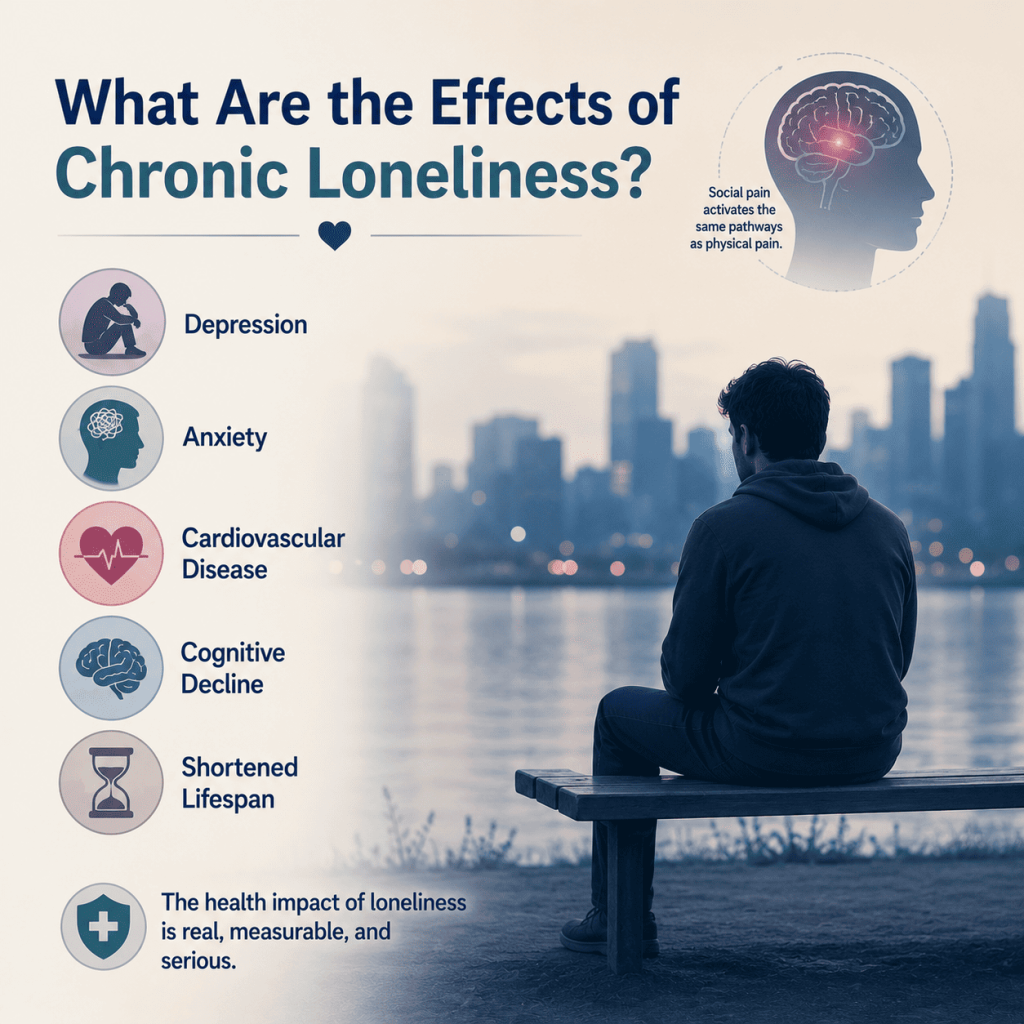
What Are the Effects of Chronic Loneliness?

The body does not treat emotional and physical pain as separate categories when it comes to loneliness. The brain processes social rejection using the same neural pathways as physical pain – which is why social exclusion genuinely hurts in a physiological sense.

What Are the Effects of Chronic Loneliness

Sustained over time, chronic loneliness keeps the body’s stress response – and specifically the inflammatory processes associated with it – persistently elevated. The downstream consequences are significant:

  • Depression: Loneliness is both a cause and a consequence of depression. The two conditions feed each other through a cycle that is genuinely difficult to interrupt without support.
  • Anxiety: Chronic loneliness increases hypervigilance to social threat – making people more likely to interpret neutral interactions as rejecting and more likely to avoid the social situations that would reduce their isolation.
  • Cardiovascular disease: Chronic loneliness is associated with significantly elevated risk of heart disease and stroke.
  • Cognitive decline: Social isolation in older adults is one of the strongest modifiable risk factors for dementia.
  • Shortened lifespan: The mortality risk associated with chronic loneliness is comparable to well-established physical health risks.
How Do I Know If I Am Lonely?

Many people do not identify themselves as lonely even when the symptoms are clearly present. Here are some less obvious indicators that loneliness may be affecting you:

  • A persistent sense of being misunderstood or unseen – even by people you spend significant time with
  • Difficulty asking for help or support, even when you genuinely need it
  • Excessive time on social media followed consistently by feeling worse, not better
  • A nagging sense that your relationships are superficial or lack the depth you are looking for
  • Difficulty tolerating solitude – using constant noise, activity, or screens to avoid the feeling of being alone
  • Frequent comparison to others who appear to have richer, more connected lives
  • Physical symptoms without clear medical cause – fatigue, poor sleep, vague aches – that may reflect the body’s chronic stress response

What Actually Helps: Evidence-Based Approaches to Loneliness

Loneliness is addressable. Not through superficial social exposure, but through interventions that target the thought patterns, relational skills, and structural conditions that maintain disconnection.

Cognitive Approaches

Because loneliness is significantly maintained by distorted thinking – the expectation of rejection, interpreting neutral behavior as hostile, believing that connection is unavailable or undeserved – cognitive behavioral approaches that target these patterns are among the most effective interventions available. A therapist can help identify and gently challenge the thoughts that keep isolation entrenched.

Quality Over Quantity

The solution to loneliness is not more social activity. It is more meaningful social activity. Intentionally deepening existing relationships – through genuine vulnerability, active listening, and real presence – is more effective than expanding the number of acquaintances. One or two relationships characterized by mutual understanding can powerfully buffer the effects of loneliness.

Community and Shared Purpose

Belonging to a group organized around a shared interest, belief, or purpose – a running club, a faith community, a creative group, a volunteer organization – provides a context for connection that does not require initiating vulnerable one-on-one relationships. It is often an accessible and low-risk starting point.

Addressing Underlying Mental Health Conditions

When loneliness is accompanied by depression, anxiety, or social anxiety, treating these conditions directly is often necessary before connection becomes genuinely accessible. Professional support can break the cycle in which mental health symptoms maintain the isolation that maintains them.

What Strong Fatherhood Actually Looks Like

Can Therapy Help With Loneliness?

Yes – and often more directly than people expect. Therapy is not just a place to discuss individual problems. For many people, it is the first consistent experience of feeling genuinely heard, understood, and accepted – a corrective relational experience that begins to shift the patterns associated with loneliness. The therapeutic relationship itself teaches people what genuine connection feels like and feels safe.

If loneliness has been a persistent part of your experience – if you recognize yourself in these descriptions and have been carrying it quietly – professional support is a meaningful and practical next step.

At The New Hope Mental Health Counseling Services, our licensed therapists help individuals navigate loneliness, depression, social anxiety, and the complex emotional terrain that accompanies chronic disconnection. As a trusted mental health clinic in New York, we offer both in-person and virtual appointments – making it easier to take the first step regardless of where you are in the city. If you have been looking for a mental health counselor in New York who genuinely listens and helps you build the connections your life has been missing, we are here. Visit www.thenewhopemhcs.com to schedule your consultation.

Loneliness Awareness Week: A Moment to Be Honest

Loneliness Awareness Week is not about making people feel inadequate for being isolated. It is about removing the shame that keeps loneliness invisible – and in doing so, making it possible to address.

If you are lonely, you are not failing at being human. You are experiencing one of the most universal human conditions. The fact that it is so common does not make it any less painful. But it does mean something important: you are far from alone in it. And that, perhaps, is the beginning of something real.

Loneliness and Mental Health — Common Questions Answered

Q1: Is loneliness a mental health condition?

Loneliness is not classified as a standalone mental health disorder, but its effects on mental and physical health are serious enough that the U.S. Surgeon General declared it a national public health epidemic in 2023. Chronic loneliness more than doubles the risk of developing depression, nearly quadruples the risk of anxiety, and carries mortality consequences comparable to smoking 15 cigarettes a day. Whether or not it is a diagnosis, it is a health issue that deserves professional attention when it is persistent.

Q2: What is the difference between loneliness and depression?

Loneliness is a subjective feeling – the gap between the social connection you have and the connection you want. Depression is a clinical condition with a distinct set of symptoms including persistent low mood, loss of interest, sleep and appetite changes, and in serious cases, thoughts of self-harm. The two are closely linked: chronic loneliness significantly increases the risk of developing depression, and depression often deepens isolation. Many people experience both simultaneously, which is why accurate assessment by a mental health professional matters.

Q3: Why are young adults the loneliest generation despite being the most connected?

The connection is largely digital rather than deep. Young adults today have more online contacts than any previous generation — and fewer people they feel truly known by. Passive social media use in particular correlates with higher loneliness scores. Add to that the instability of early adulthood — new cities, new jobs, fewer built-in social structures — and you have conditions where surface-level connection is abundant but genuine belonging is scarce. Real connection requires vulnerability and consistency, two things that digital interaction rarely delivers.

Q4: Can therapy actually help with loneliness?

Yes — and often more directly than people expect. Cognitive behavioral therapy helps identify the thought patterns that reinforce isolation, such as anticipating rejection or interpreting neutral interactions as hostile. Beyond technique, the therapeutic relationship itself is a corrective experience — for many people, it is the first consistent experience of feeling genuinely heard and understood. That experience begins to shift the internal patterns that keep loneliness in place. A mental health counselor in New York can help you understand what is driving your loneliness and build a realistic path toward connection.

Q5: How do I stop feeling lonely when I am surrounded by people?

This is one of the most common and painful forms of loneliness — feeling invisible in a crowd. It usually signals that your relationships lack depth rather than number. The path forward involves intentionally deepening at least one or two existing connections through honesty and real presence, rather than adding more social activity. It may also involve examining what makes genuine connection feel unsafe or unavailable. If loneliness persists despite being socially active, speaking with a therapist is the most effective way to understand what is actually happening beneath the surface.

Take the first step toward better mental health!

Fill the Below Form and Schedule a Clinical Consultation with us today→

Skip to content