
The New Hope MHCS

The Father Factor: Men's Mental Health, Fatherhood, and Why Asking for Help Is the Strongest Thing You Can Do

There is a particular kind of pressure that comes with being a father. It is rarely spoken about directly. It lives in the expectation that you will be the steady one – the provider, the protector, the one who holds things together no matter what is falling apart on the inside. It lives in the moments when you are exhausted and overwhelmed but tell yourself that asking for help is simply not something you do.

June is both Men’s Mental Health Awareness Month and the month that holds Father’s Day – a meaningful intersection that invites something long overdue: an honest, data-grounded conversation about the emotional lives of men and fathers specifically.

This is that conversation.

The State of Men's Mental Health in 2026

The statistics around men’s mental health are both alarming and persistent. Men account for nearly 80 percent of all suicide deaths in the United States. They are significantly less likely than women to seek mental health treatment, less likely to receive a mental health diagnosis, and more likely to use substances as a primary coping mechanism. Men’s Mental Health Awareness Month was established in 1994 specifically to confront this reality – to break through the cultural conditioning that teaches men, from childhood onward, that emotional struggle is a private failure rather than a shared human experience.

Fatherhood adds another layer of complexity. Research consistently shows that fathers experience significant mental health challenges – during the transition to parenthood, across their children’s developmental years, and during major life transitions including divorce, job loss, and the departure of adult children from the home. Yet paternal mental health remains one of the least discussed and least resourced areas in the mental health field.

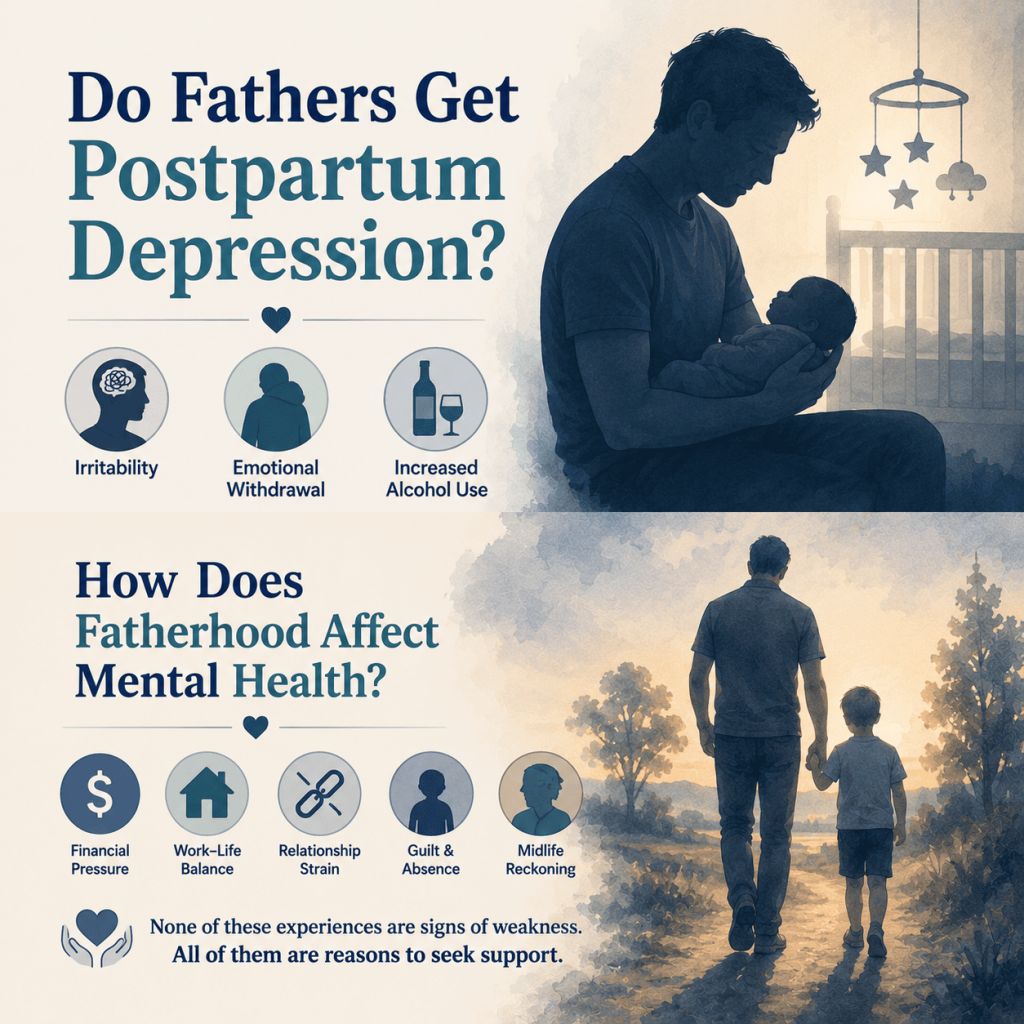
Do Fathers Get Postpartum Depression?

Yes – and more commonly than most people realize. Studies show that between four and ten percent of new fathers experience postpartum depression, a figure likely to be an underestimate given how rarely paternal mental health is assessed or acknowledged following a birth.

Fathers experiencing postpartum depression are less likely to recognize it in themselves and far less likely to report it to a healthcare provider. The symptoms often look different than they do in mothers: more irritability, emotional withdrawal, increased alcohol use, and immersion in work rather than the visible sadness more commonly associated with the condition. A new father who seems distant, angry, or unusually consumed by work may not be disengaged – he may be struggling.

Do Fathers Get Postpartum Depression

How Does Fatherhood Affect Mental Health?

Beyond the newborn phase, fatherhood brings ongoing stressors that accumulate over years. Financial pressure. The tension between work demands and being genuinely present at home. The fear of replicating painful patterns from one’s own upbringing. The grief of a relationship ending and the guilt of not being a daily presence in a child’s life. The midlife reckoning that often comes when children reach adolescence and fathers are confronted with unresolved questions about their own lives.

None of these experiences are signs of weakness. All of them are reasons to seek support.
Why Don't Men Seek Mental Health Help?

Understanding why men – and fathers specifically – avoid mental health care is essential to addressing the gap. Three interlocking factors tend to dominate:

The Stoicism Mandate

From a young age, many men absorb the message that strength means endurance. That vulnerability is dangerous. Fatherhood intensifies this pressure. Children are watching. Partners are depending. Asking for help can feel like admitting failure at the most important role in your life. That fear is understandable – and it is also one of the most costly misunderstandings in men’s health.

The Provider Identity

Many fathers carry a deep identification with their role as provider and protector. Mental health struggles can feel fundamentally incompatible with that identity. If your sense of self is built on being capable and reliable, acknowledging that you are struggling can feel like an existential threat rather than a step toward healing.

Practical Barriers

Even for men who want help, accessing it presents real challenges. Therapy appointments often happen during work hours. Mental health conversations feel unfamiliar. Finding a therapist who fits requires energy that is impossible to muster when already depleted. And men are more likely to have been socialized away from the kind of reflective, emotionally open conversation that therapy typically involves – making the first session feel particularly uncomfortable.

What Strong Fatherhood Actually Looks Like

The cultural narrative around fatherhood is slowly, meaningfully shifting. More fathers than ever are openly acknowledging that they struggle, that they have sought therapy, that they are actively working on themselves – not in spite of being good fathers, but because of it.

Here is what the research consistently shows: children with fathers who model emotional openness, help-seeking, and healthy coping develop stronger emotional intelligence. They are more likely to seek help when they struggle. They are less likely to carry forward the stoicism mandate that has caused harm across generations. When a father prioritizes his mental health, he is not choosing himself over his family. He is doing one of the most protective things he can do for every person in it.

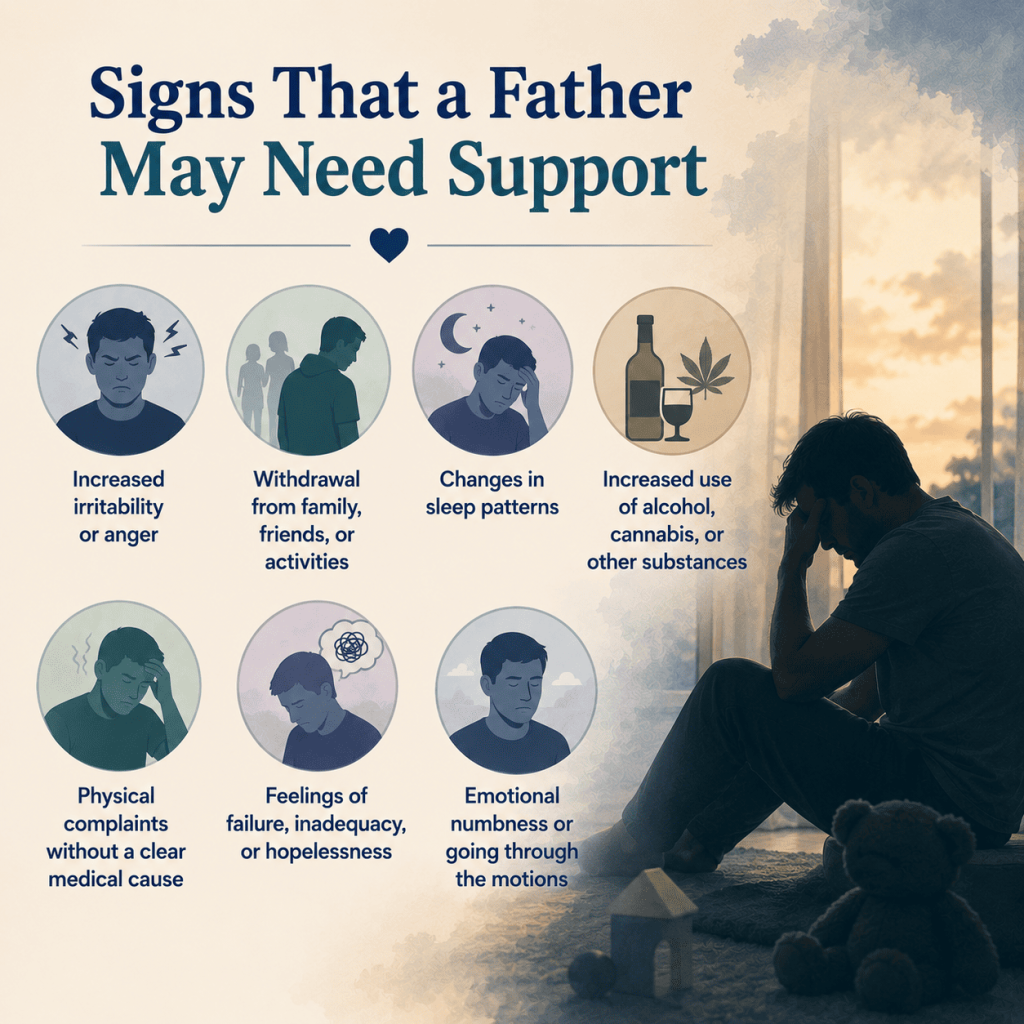
Signs That a Father May Need Support

Mental health struggles in men often look different from what popular culture depicts. Watch for these warning signs:

  • Increased irritability or anger, particularly in situations that would not have previously triggered strong reactions
  • Withdrawal from family, friends, or activities that previously brought genuine pleasure or connection
  • Significant changes in sleep patterns – sleeping far more or far less than usual
  • Increased use of alcohol, cannabis, or other substances to cope with stress
  • Physical complaints – chronic fatigue, headaches, digestive problems – without a clear medical cause
  • Persistent feelings of failure, inadequacy, or hopelessness related to the parenting or provider role
  • Emotional numbness or the sense of going through the motions without genuine engagement
What Strong Fatherhood Actually Looks Like

How to Start the Conversation

At The New Hope Mental Health Counseling Services, we understand that men and fathers face unique barriers to mental health care – and unique needs when they do reach out. Our licensed mental health counselors in New York provide confidential, judgment-free support for men navigating depression, anxiety, relationship challenges, the transition to parenthood, divorce, grief, and the complex terrain of fatherhood. As a trusted mental health clinic in New York, we offer flexible scheduling including evening appointments, and both in-person and virtual sessions built to fit around a father’s real life.

This Father’s Day, the most meaningful investment you can make is in a version of yourself that is not running on empty. Visit www.thenewhopemhcs.com to connect with a mental health counselor in New York who understands what you are carrying – and who can help you carry it differently.

Final Word

Asking for help is not a sign that you have failed as a father. It is a sign that you understand what full presence actually requires. The strongest fathers are not the ones who feel nothing. They are the ones who feel everything – and make the honest choice to deal with it.

Men's Mental Health & Fatherhood - Your Questions Answered

Q1: Can fathers get postpartum depression?

Yes. Studies estimate that between 4 and 10 percent of new fathers experience postpartum depression – a figure likely higher given how rarely men report emotional symptoms to a doctor. In fathers, it typically shows up as irritability, emotional withdrawal, overworking, or increased drinking rather than visible sadness. If you are a new father feeling persistently disconnected or unlike yourself, speaking with a mental health professional is the right next step.

Q2: Why do men avoid seeking mental health help?

Most men grow up absorbing the message that emotional struggle should be handled privately and silently – that reaching out signals weakness rather than wisdom. Fatherhood adds another layer: many men tie their identity to being capable and in control, making vulnerability feel threatening. Practical barriers like rigid work schedules, unfamiliarity with therapy, and not knowing where to start compound the problem. The result is a pattern of delaying care, often for years, at significant personal cost.

Q3: How does fatherhood affect a man's mental health?

Fatherhood reshapes identity, routine, relationships, and financial reality all at once. Many men find that becoming a father surfaces unresolved emotions from their own upbringing – old patterns they were hoping to avoid repeating. The 2026 State of the World’s Fathers report found that three in four fathers reported losing sleep over financial pressure, and that economic stress was directly tied to every mental health indicator measured. The emotional and mental load of modern fatherhood is substantial – and largely invisible.

Q4: What are the signs of depression in men?

Male depression rarely looks like the textbook picture. Instead of visible sadness, it tends to show up as persistent irritability, anger, emotional numbness, withdrawal from family and friends, increased alcohol or substance use, risk-taking behavior, and physical complaints like fatigue or chronic pain. Many men dismiss these signs as stress or a rough patch – which is exactly why male depression so often goes undiagnosed and untreated. If these patterns have been present for several weeks, a mental health counselor in New York can help make sense of what is happening.

Q5: Is therapy actually helpful for men and fathers?

Consistently, yes. Cognitive behavioral therapy, individual counseling, and men-specific therapeutic approaches have well-documented track records for treating depression, anxiety, relationship strain, and the pressures of fatherhood. Beyond symptom relief, there is a broader benefit: fathers who model help-seeking and emotional openness raise children who are more likely to do the same. The first session is often the hardest step. It is also frequently the one that changes everything.

Take the first step toward better mental health!

Fill the Below Form and Schedule a Clinical Consultation with us today→

Skip to content